“The perfect work induces the desire to live in it.” Virilio, The Vision Machine, p. 28
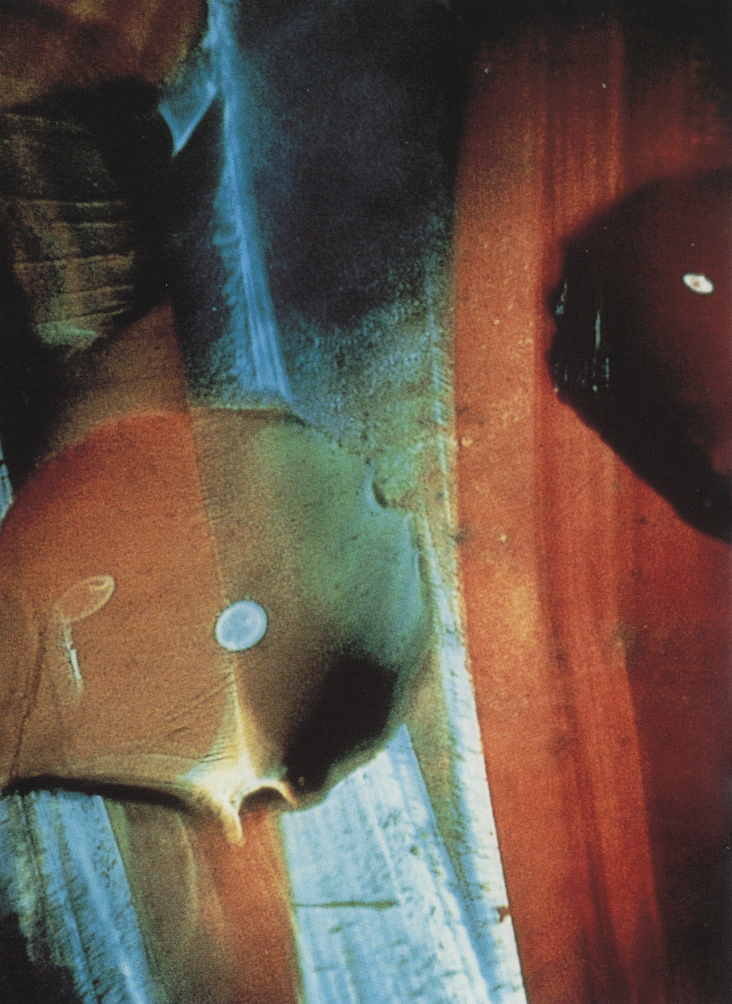
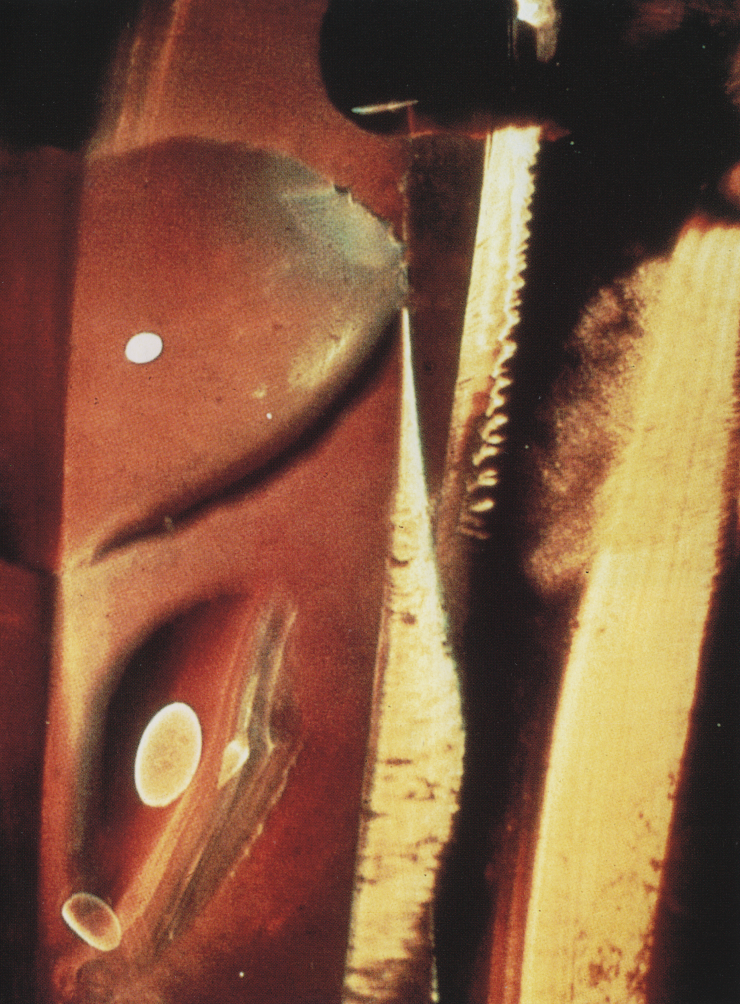
These are facing panels for a single frame that occupies left and right pages in a small Phaidon anthology of Wynn Bullock’s work (b. 1902-d. 1975). The images were scanned on a CanoScan 200 Lide last supported by Windows 8.1 using Linux’s XSane at 2400dpi. Chris Johnson and Barbara Bullock-Wilson write of these “color light abstractions” c.1960 that “Bullock worked with an old 35mm Exacta camera with a dual-rail bellows attachment and Kodachrome II Tungsten film. Utilizing a homemade stand that held several layers of clear glass, he would place on the topmost panes fractured pieces of optical glass from an observatory lens. On the lower levels he would arrange shards of stained glass and crumpled sheets of bright cellophane. Other light-refracting materials, including honey and droplets of water, might also be added. Surrounded by photofloods, spotlights, and prisms, Bullock would then bring his camera lens sometimes as close as 1/16 of an inch to the subject matter. He would create his pictures by manipulating all the different elements and controlling the focus mechanism so that object reality was lost.” (68-69).
- Tue Aug 18 8:05AM
- Tue Aug 18 7:00PM
- Wed Aug 19 11:22 AM
- Thu Aug 20 8:25 AM
- Fri Aug 21 8:11 AM
- Sat Aug 22 12:28 AM
- Sun Aug 23 2:13 AM
- Mon Aug 24 8:28 AM
- Tue Aug 25 8:00 AM
- Wed Aug 26 9:22 +12:48
- Thu Aug 27 6:06 AM
- Thu Aug 27 3:58 PM
- Fri Aug 28 2:47 PM
- Sat Aug 29 1:09 PM
- Sun Aug 30 1:09 PM
- Mon Aug 31 9:48 AM
- Tue Sep 1 12:13 PM
- Wed Sep 2 9:58 AM
- Thu Sep 3 11:44 AM
- Fri Sep 4 12:45 PM
- Sat Sep 5 3:04 PM
- Sun Sep 6 3:04 PM
- Mon Sep 7 8:38 PM
- Tue Sep 8 4:38 PM
- Wed Sep 9 10:15 AM
- Thu Sep 10 7:30 AM
- Fri Sep 11 9:36 AM
- Sat Sep 12 1:41 PM
- Sun Sep 13 1:23 PM
- Mon Sep 14 5:50 PM
- Tue Sep 15 8:36 AM
- Tue Sep 15 8:20 PM
- Wed Sep 16 5:47 PM
- Sat Sep 19 3:09 PM
- Sun Sep 20 11:51 AM
- Mon Sep 21 3:50 PM
- Tue Sep 22 8:09 AM
- Wed Sep 23 9:13 AM
- Wed Sep 23 4:15 PM
- Thu Sep 24 8:13 AM
- Thu Sep 24 12:15 PM
- Fri Sep 25 8:11 AM
- Sat Sep 26 3:58 PM
- Mon Sep 28 3:14 PM
- Tue Sep 29 4:00 PM
- Wed Sep 30 8:18 AM
- Fri Oct 2 7:39 AM
- Fri Oct 2 12:44 PM
- Sat Oct 3 [in process]
