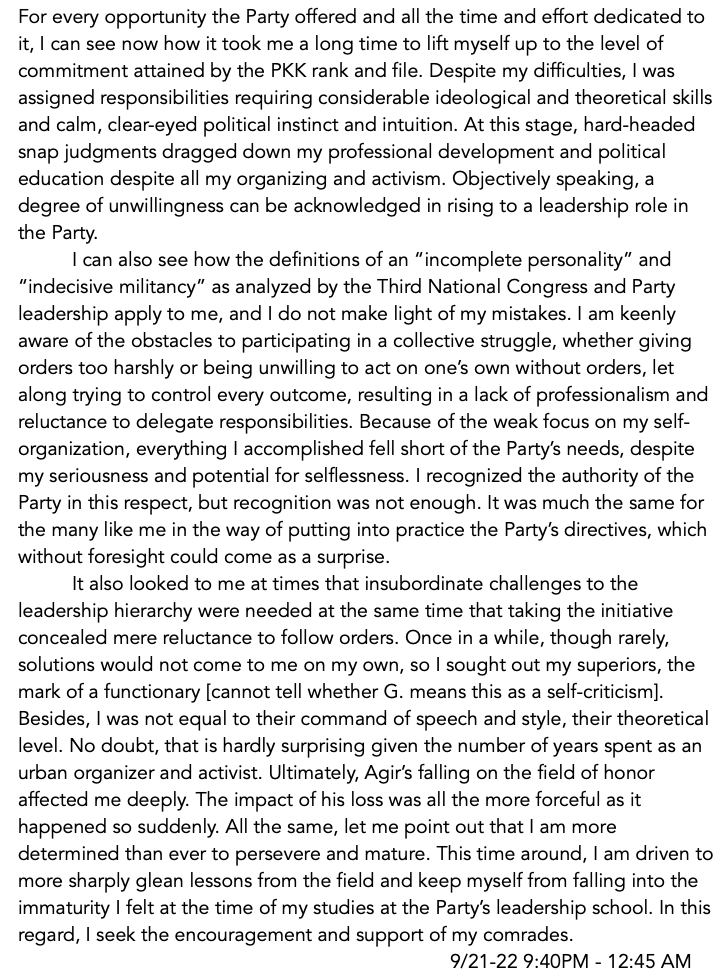
Ersöz signs the Diary’s introduction 15 December 1996, Zeynep. The substitute timestamp records the first time the draft translation developed in a notebook with multiple variants, using Google translate on a phone rather than (missing) dictionary. The substitution might be viewed as a subconscious act of appropriation, or expression of concern for blurring boundaries between literary (poetry) and life (diary) writing. The journal begins with seven lines of poetry.
Question: Did Ersöz have access to any accounts of the pre-1917 Rabonitsa?
Inessa Armand, editor-in-chief of Rabonitsa, meets Gurbetelli Ersöz, editor-in-chief of Özgür Gündem
An article by the Turkish journalist and author, Nadire Mater, appeared at the time of the publication of the French translation of Gurbetelli Ersöz’s diary. Bianet’s translation engine returns too many mistakes in translation to be useful. So here are some highlights from Mater’s biographical profile, using Google translate:
Mater quotes from a heading from the final diary entry, October 8, 1997: “Just as I fight against the male, I will make woman beautiful – starting with myself.”
Searching without result for the subheading in the French edition, the third-to-last paragraph before a ten-line poem ends the diary appears:
Des jeunes femmes guerilleras remplies d’ambition et de passion de s’embellir et se liberer, vont indispensablement exploser contra la trahison du collaborateur qui joue actuellement le role d’une perdrix chantant d’une tres belle voix.
Young women fighters, replete with ambition and passionate for their beatification and liberation, are bound to lash out against the betrayal of the collaborator—who is currently playing the role of a decoy bird singing with a beautiful voice. (Modified Google translate; the machine misses the possible echo of the 1950s Beat riff, which in the Turkish may sound close to individual subjectivity self-sublating into humanity consciousness (the note on which Ersöz begins the diary)).
Mater notes further affirmations of revolutionary feminism by Ferda Çetin, among other contributors to the diary’s conclusion.
Mater quotes at length from the interview in which Ersöz talks about being tortured, her groundbreaking work breaking gender boundaries as an editor-in-chief, and the time for study prison made possible, “it was wonderful to have plenty of time to read – and, or course, to think.”
Details of an old Azeri folk song, a Bingöl dance, and zilfef, a dish made of dough end the passage on the six months served in Bayrampaşa Prison.
Yurdusev Özsökmenler is quoted: “There are some people whose very essence is violence – even their speech. Gurbetelli was never like that.”
The last sentence of Nadire Mater’s tribute: “Traces of electric shock torture are still visible on her lips and hands.”