“(I would love to do that to all of you, I even thought of it. I thought well we’ll just ask everyone in this audience to write a blasphemy. I wonder how many of us even know what to blaspheme.)” Robin Blaser, New College Chapel, June 1986
ACTS 6, A Book of Correspondences for Jack Spicer, ed. Levi Strauss and Hollander
The Quadrant



Prole-legomena to a study of failed Orphism among the second generation of the San Francisco Renaissance. New Narrative and L=A=N=G=U=A=G=E poetics deadlock since both complete earlier forms and tendencies. This premise can be tested by the amenability of both aesthetic approaches to implementation in American universities. Their achievement rests with their revitalization of creative writing program literature described by Jameson (2015). New Narrative’s flagship text is Arctic Summer precisely because the roman-a-clef exposes the limitations of writing real names into real life textuality prior to social revolution. The “laminar flow” (McCaffery) of post-structuralist verse anticipates machine-mediated textuality and may find a renewed purpose in expanded installation and public works using automated sign systems to combat AI human language colonization.The term failed Orphism refers to the profound error of circle mentality and suppressed nascent effort to found a Samizdat collective on the eve of university incorporation of the Black Mountain-New College Olson-Duncan nexus. The failure is socio-cultural, and as such, political rather than formal. Imminent historical crisis will attest to the vital need for independent and self-governed artist collectives or artist-activist communes. Research is needed for comprehending the rise of writers’ congresses entre les deux guerres, the role of state socialism in funding them, and the counter tendency of Trotsky and Breton among other surrealists. This first broad sketch of a post-HOWBEIT study (proposed completion date: 2030), will combine New Critical close reading that survived, among other places, in Polish philology; New Narrative problematics of cultural authority in the form of the author’s name and right to property; and Marxist class analysis. Categories by definition overreach and oversimplify. Additional elements outside this preliminary schema include, among other singularities, Howe, Scalapino, Alexander, and Robertson. A potential thesis countering the proposed deadlock between New Narrative and L=A=N=G=U=A=G=E is bpNichol’s Martyrology, which draws nearest HOWBEIT’s process groundwork for digital video and photography. The Martyrology sublates textuality into an open-ended and diaristic art-life narrative lyricism capable of meeting global indigenous oral traditions without appropriating them. By 2035, the study will accompany the publication of Thracian Glosses in part to prepare readership, a hard-learned lesson from thirty years of silence following the publication of Recent Events. Thracian Glosses purports to complete the quadrant of the postwar San Francisco Renaissance by restoring the H.D. Book’s suppressed Trotskyism and anticipates appearing on the eve of immense international class struggle to prevent a third world war.
July 24, 1999 or 2000
Views from the Reservation
The final sentence to the note on “Open Letter to the Editors of Apex of the M” reads: “To me the Awards still seem offensive, but as I have discovered, most people don’t think they were all that bad. I’m chastened.”
For readers of Arctic Summer, “chastened” is overdetermined. Flipping code words, or “makin’ flippy floppy” (Talking Heads), is a standard move of non dit textual fetishism; still, knowing all you know, all that you remember, all that you overheard, all that you have read, it is difficult not to read a message in a bottle: I have been whipped into submission.
The last paragraph of Arctic Summer never ceases to thrill its self-appointed designated reader:
Now, in his perfectly shaped and situated studio, safe from the glance of Ralph as he stood at the stove or ironing board, the snide (or even flattering) comments of the delivery boys and repairmen through the apartment on their way to the kitchen or bathrooms, the careless swipe of Jack’s or Jezebel’s tail, George stood in front of a blank canvas in the center of the missing, rebuilt room – the very image he had had of himself when he was young. Unwitnessed, he looked out on trees, a basketball court, the ice-blue river, clouds of dark gray smoke that a burning pier a mile and a half away sent into the sky. Behind him was a storage rack for his prints, shelves for his fixatives, drawers for his paper and film, a steel table piled with trays, chemical baths, and the hair dryers he used to slow down the image. His old couch was there, the one on which he and I used to have so much fun, and a chair whose stuffing was falling out. On the wall in front of him was tacked a four-by-six foot blowup of a mouth, ready to receive whatever image he chose. He opened a tube of BLOCKX cobalt-blue paint, squeezed some onto his palette, picked up a three-inch bristle brush, and started to paint.
San Francisco, 1986 – 1996
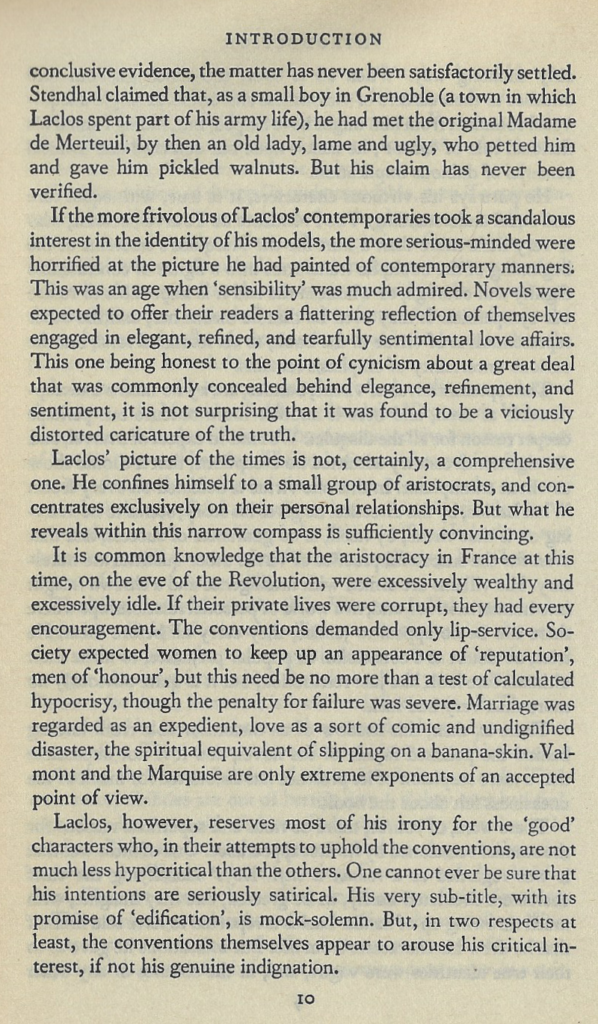
Internalizing the stricture delivered by the Laclos of the second-generation of the San Francisco Renaissance, “she’s ambitious,” you fretted, anxiety stricken, over the MLA symposium that closes the chapter, “The Marrying Kind” (184). Who? (Zyzzyva No. 45 posted June 17, 2019). Who was the target, the intended reader, for the satire? Was Laclos accusing you of the will to make money from your poetry? The advent of “neoliberalism, with the specter of increased professionalism in the arts” Writers xx) echoes Jameson’s “Dirty Little Secret” published four years earlier in The Ancients and the Postmoderns. Immediately following your first post to the Buffalo Poetics List – to which you were lured – Silliman posted the subject heading: Not This Pig. You recognized the method from Arctic Summer. It needs theorizing, just as the entire archive of the Buffalo Poetics List needs to be printed to correct Watten’s chapter in The Stalinist Moment (2003).
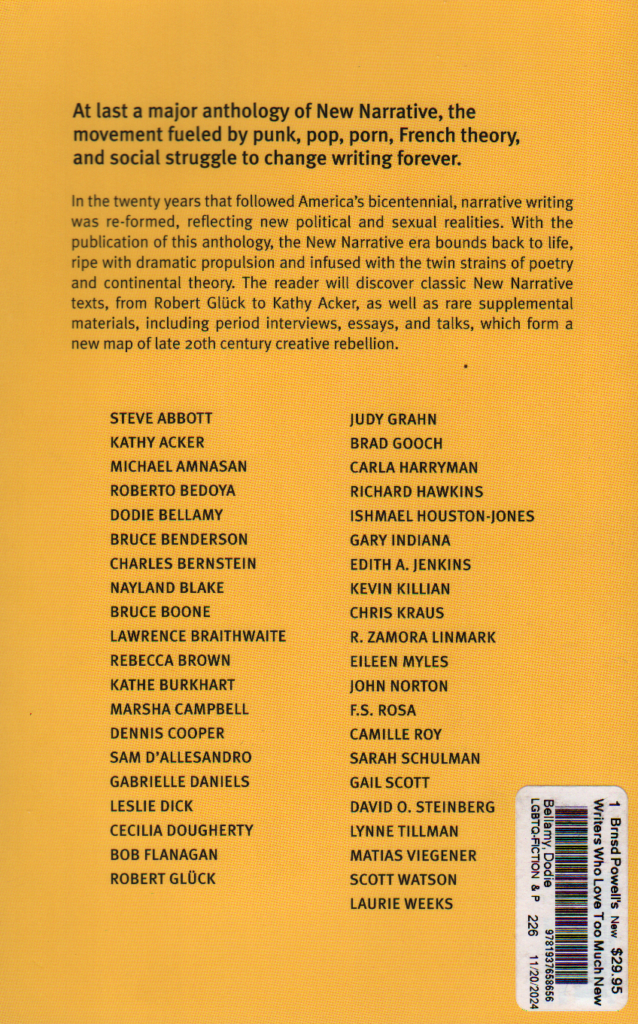
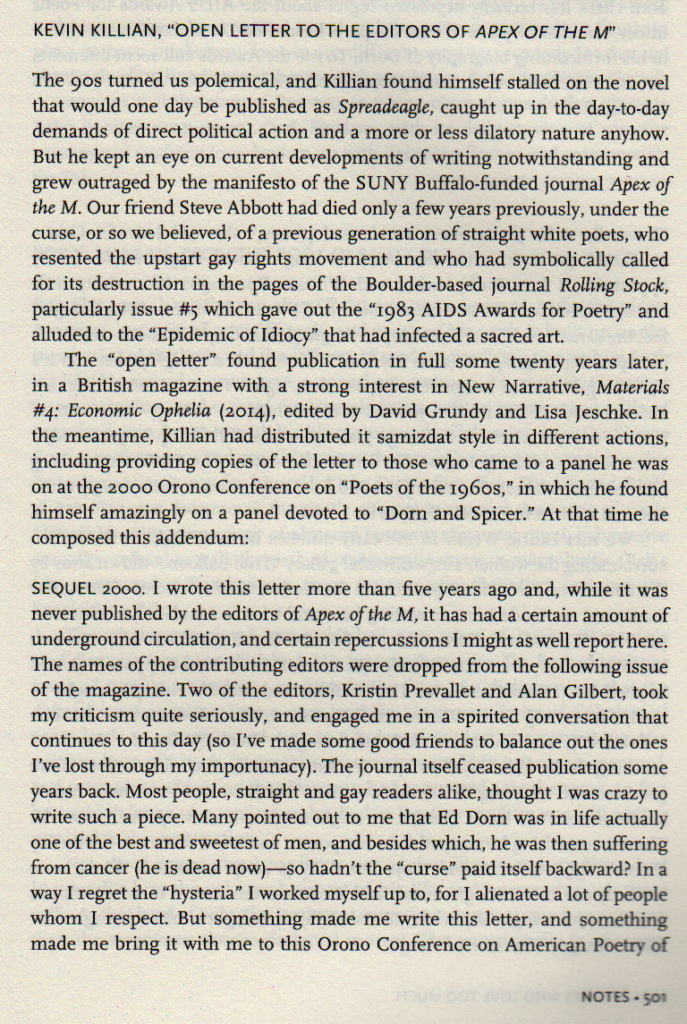
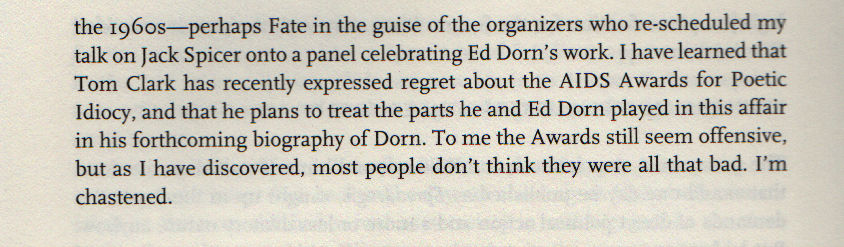
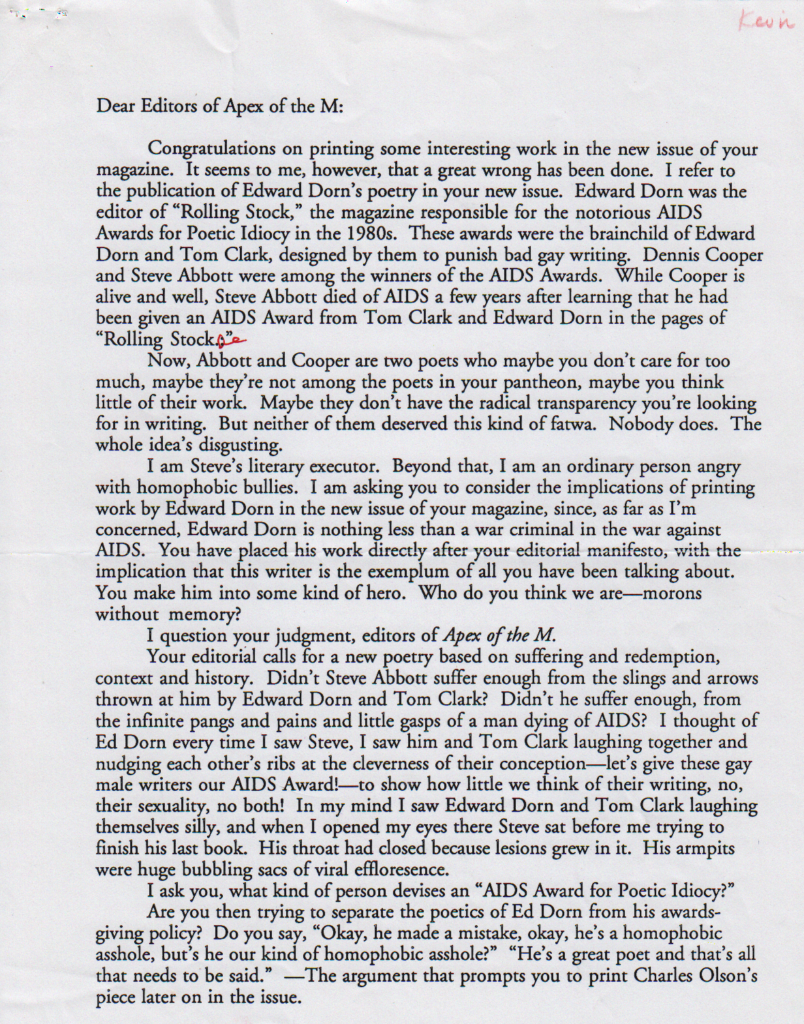
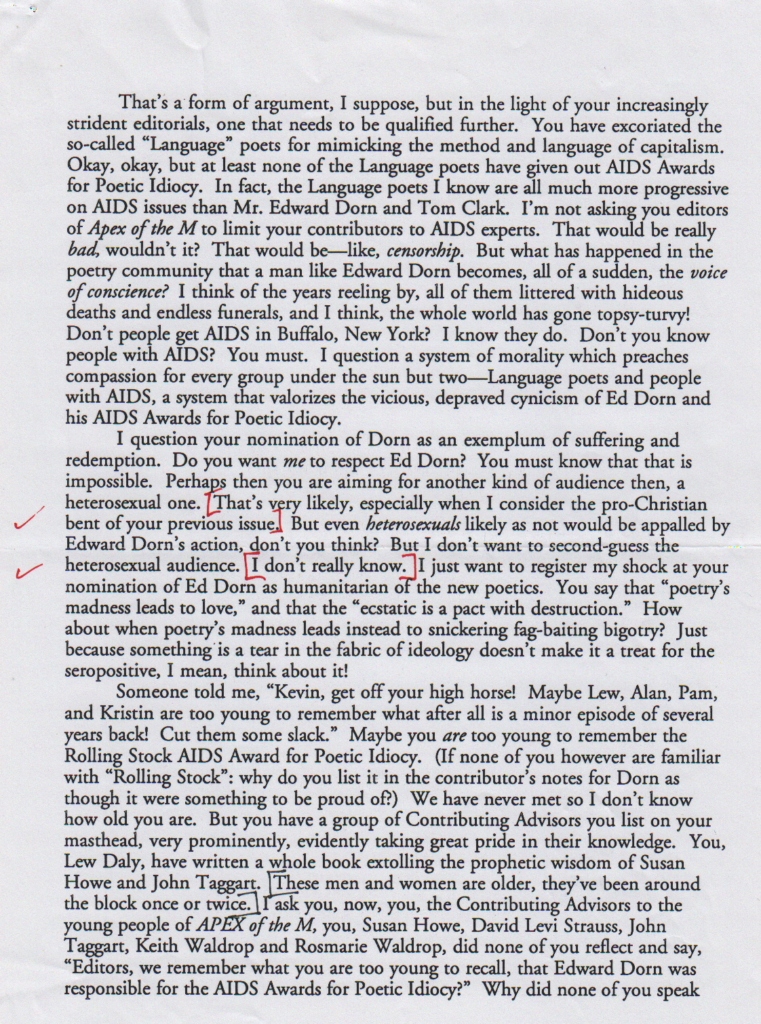
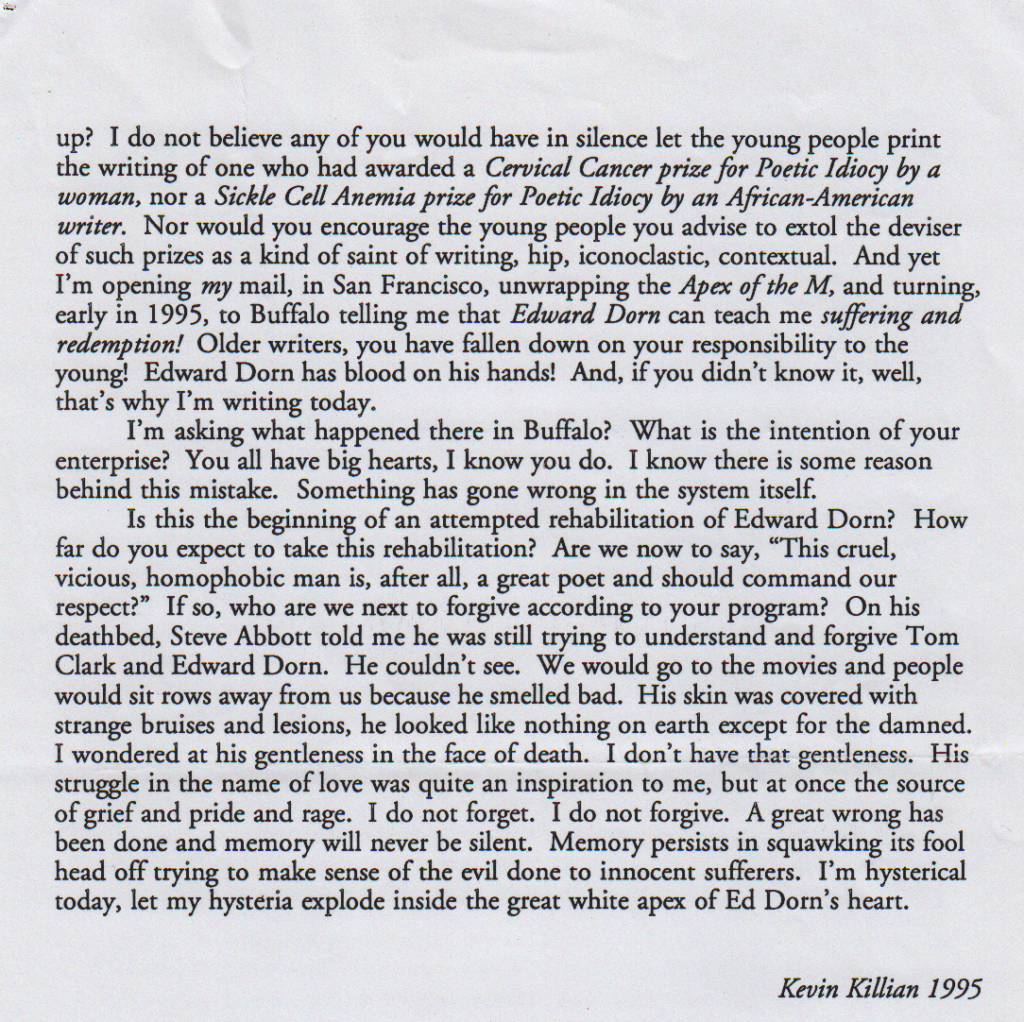
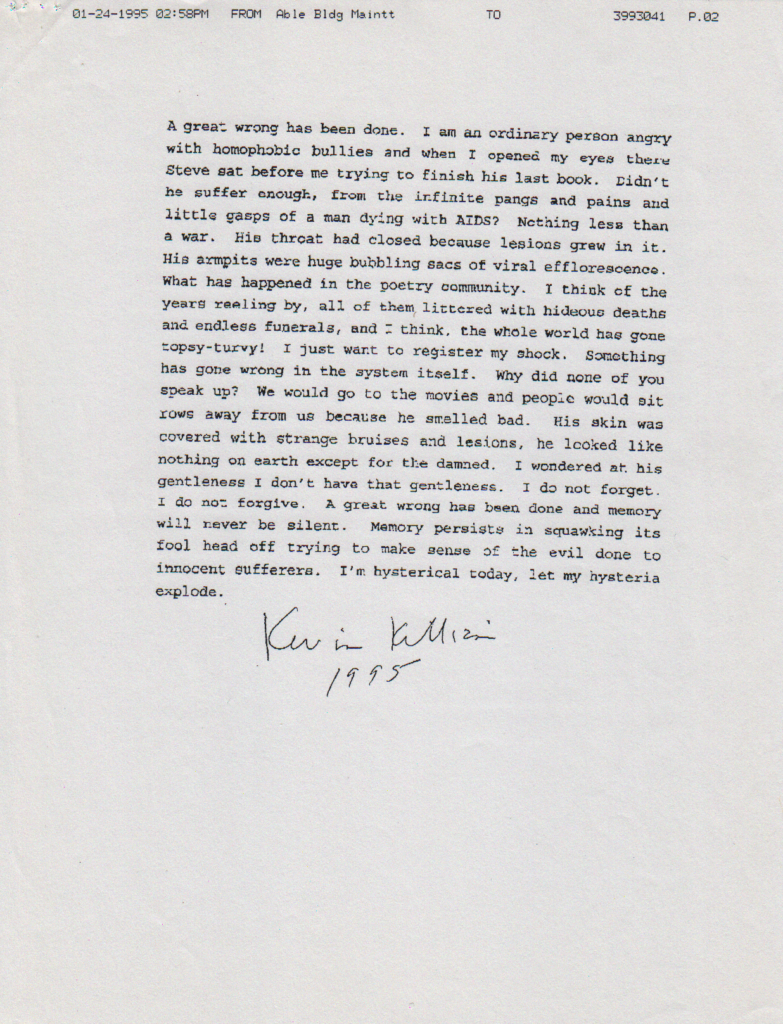
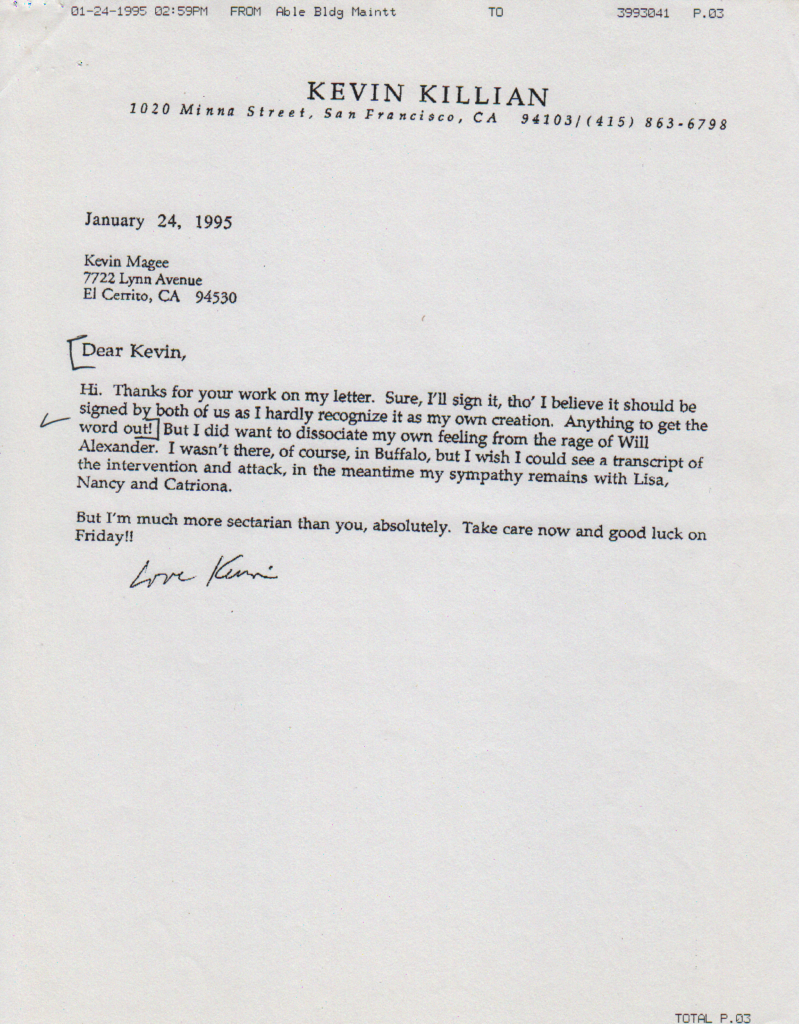
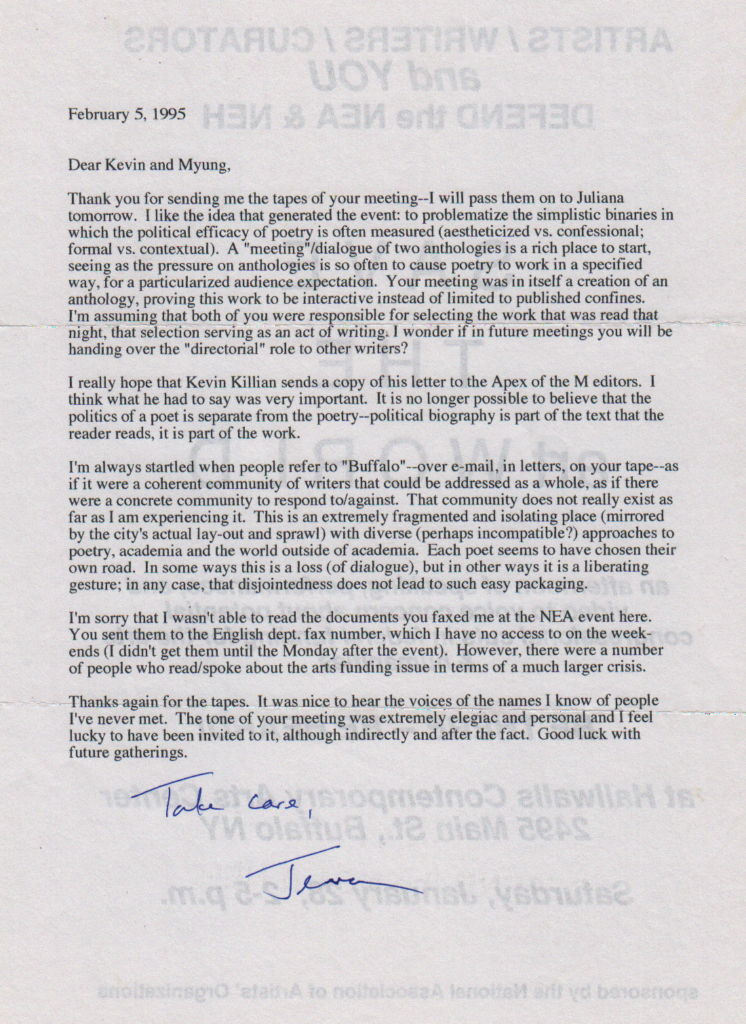
1995 Samizdat


At lunch in Vancouver with Howe, Bernstein, Scalapino, Silliman, and Kim, you gave Bernstein (one or more?) copies. Like the cassette you sent Osman of your reading the condensed version of the Apex of the M that Killian signed, did these documents get deposited in Buffalo’s Special Collections?
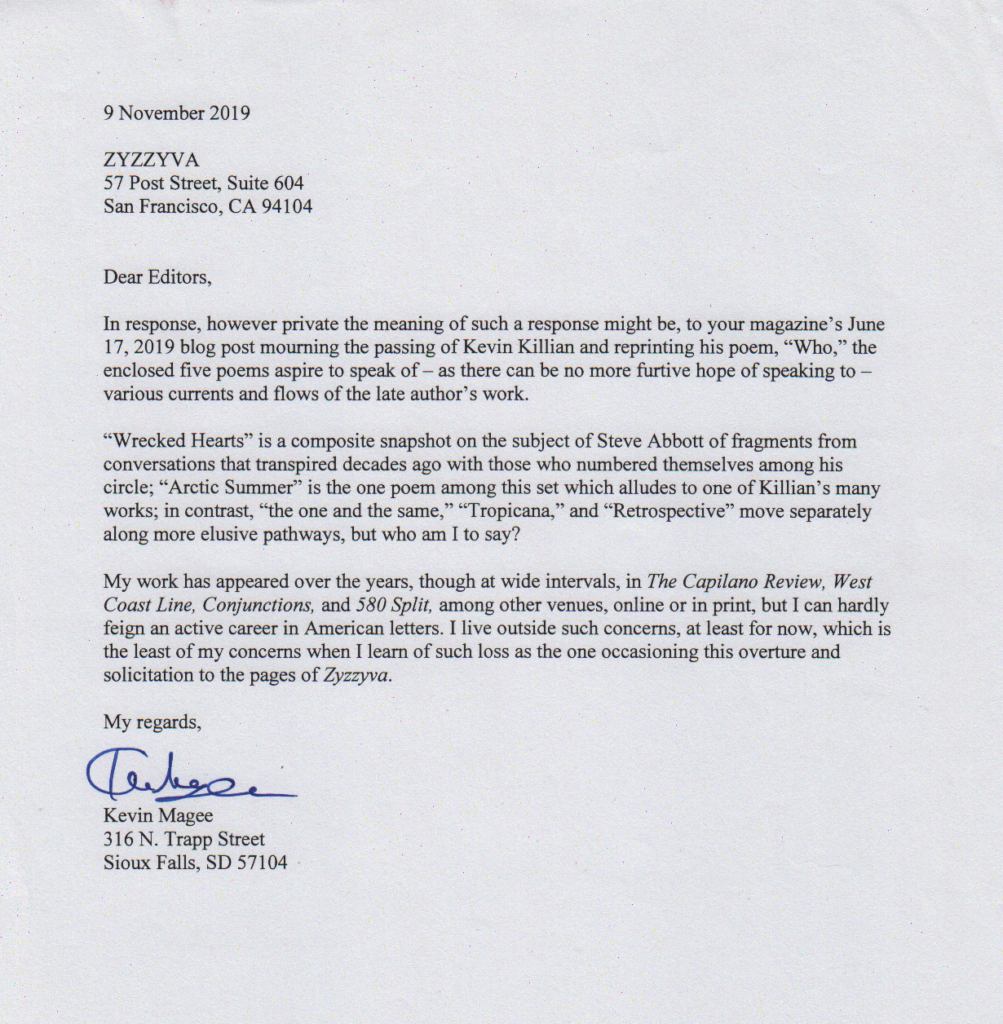
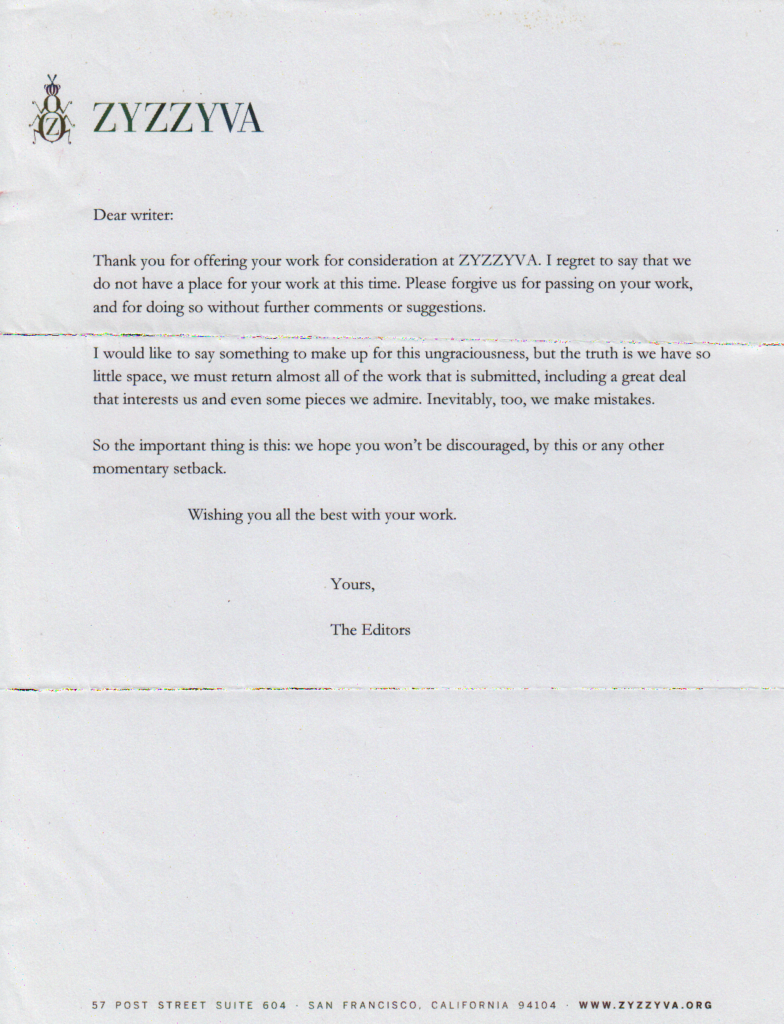
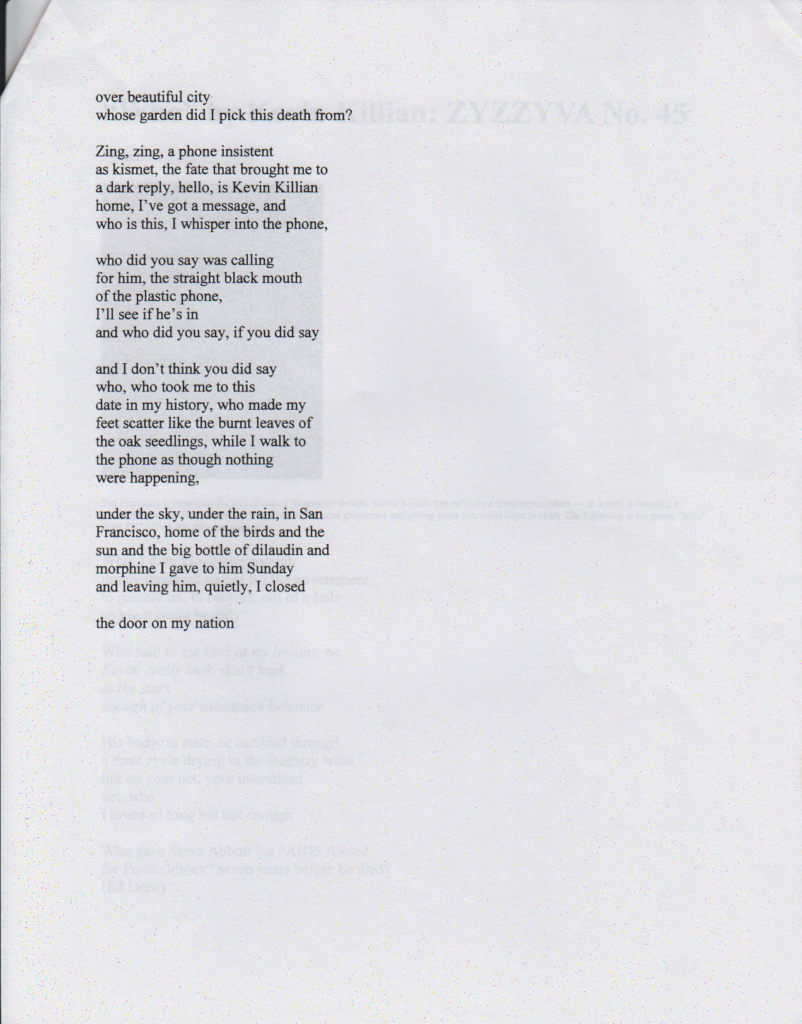
The last word of the last stanza on the last page of Zyzzyva’s June 17, 2019 blog post does not overturn Spicer’s famous “The poem does not know who you refers to” (which must have meant something vastly different for Spicer’s bohemian milieu than its present-day engine for indirection, or mannerism – period style) so much as insist on its own variety of grammatical unrest: The poem does not know who Who refers to. Does it matter who is closing the door on an entity called nation? It matters if the voice belongs to James Clarence Mangan. It matters if the voice belongs to any poet writing in any language from a specific time and place where self-determination, if not survival, is threatened. Yesterday’s news of recent socio-cultural openings in Syria for Kurdish inclusion gesture towards the beginning of these notes committed to connecting memory to documents: Eva’s absence. Pathfinder Bookstore. The visitor. Kurdish aspirations. “Art does not float above social relations,” the former speaker is quoted as saying in one of the 19X19 poems. Social class. Even in Roy’s 2008 blog post society is nowhere near, limiting the concept to mere term. Don’t wonder whether German or Russian use a compound equivalent for society class, oh, there you are: class society. An economic and political category. The Second International collapse that the next time around should have made Oppen’s enlistment impossible: Proletarians don’t even have a country let alone a home town. Perelman was right about Vergil in the Code of Signals essay, as useless as any comparison to Rome must be. Killian’s “my nation,” whoever is saying it, and to whomever it is said, has that Duncan-Olson aura, despite all that is now known about just how rotten the 1950s were for the working class, an infinitely flexible, dynamic, and expansive economic and political category that each wave of immigration strengthens. “My nation?” My city, my property, my place and time. Why for this poet is it so hard to say, “I opened the door to the rest of the world.” I opened the door to the hungry, the homeless, the stateless, the pariahs of East Cleveland and all points home beyond?
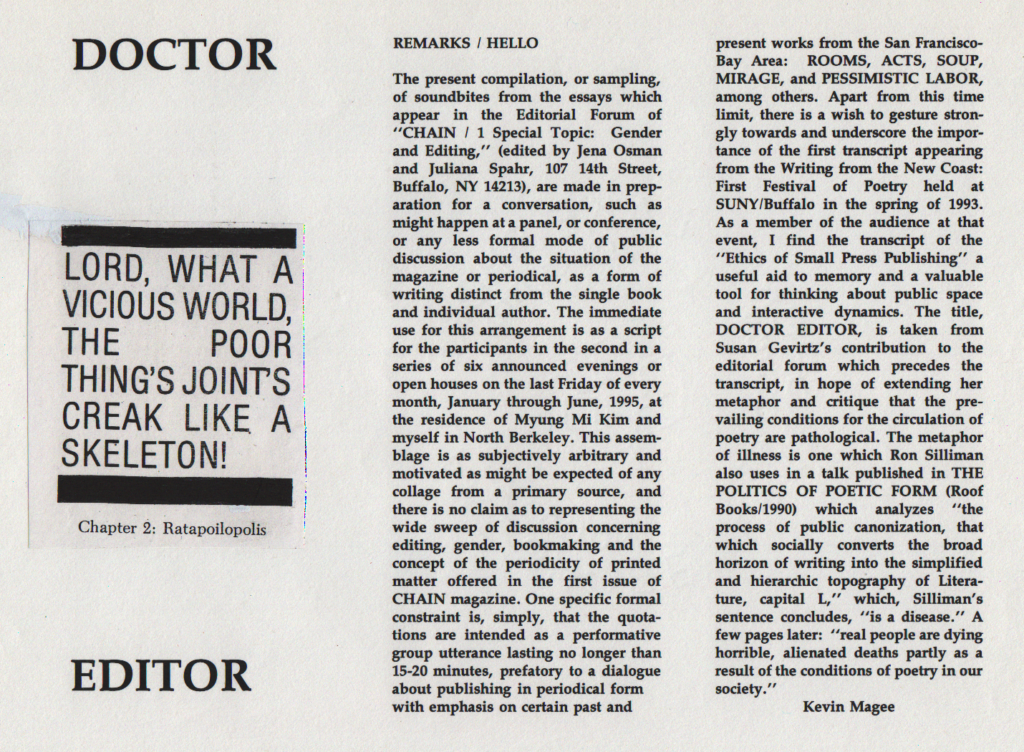
Keywords: colonialism, design culture, editorial autonomy, power, property, shadow editors/authorization, symbolic capital,
The Road to Basra poems appear choreographed. Pat Sims called you to proof every line of each poem, a singular and never-repeated attention to textual accuracy and intention. Howe’s Rückenfigur used the same meter as the last poem in one of the several extended series in Recent Events. “All that in one year?” (You mailed her a copy, as you did for several other poets whom you did not see at Canessa Park). What was Graham doing in the same issue? (Howe did say something like “so you come from that program” when the two of you met her at New Coast). In 30 years, no one has written a word about the book in public, at least that you know of, until Alibi Lullaby (unless the metamorphic repetition of recent events in those pages is an accident). Credulity evaporates into absurdity to assume there have been no private conversations. (“That’s what they do, that’s all that they do!” Alien 2). “Stalin communicated the motion by telephone” (quoted from memory). Severity of transposing realpolitik onto cultural affairs between Buffalo and San Francisco. It must be wrong, you must be wrong, to imply that poets behave like party hacks. Previous cultural formations tell no similar stories? The only historical analogy you are sure of is the British historians’ view of clerical culture in the late middle ages and their picture of the power of church and court and invisibility of the lower clergy in the countryside. Marxism calls the modern process proletarianization.
“Then there is the whole stratum of petty bourgeois who are entirely in an employee condition, and are thus in a purely economic sense already proletarianized, but psychologically experience a conflict between their hatred of the proletariat, assimilation to which they refuse, and their frustrations at the ‘ingratitude’ of their employers, with whom they feel allied but who ill repay them for their solidarity” (Timpanaro, On Materialism, 113-114)
Re Benjamin’s insight that proletarian children are born into the next generation of their class rather than into a family (uneasy with Timpanaro’s defense of Reich – the sociological titles are populist and patronizing), has open Oedipalization in uneducated households been researched? Hejinian’s “I’m not her mother!” instances how petit-bourgeois social layers are obsessed with the return of the repressed, and Arctic Summer is shot through with parodic mimicry of family relations. The small family is a recent historical development among proletarians. The larger the family, the greater the desire circuitry among siblings. In smaller families, how often does the father “take” the daughter and the mother “take” the son? Such open Oedipalization, if it exists among the lower classes, may inform Benjamin’s insight. Economic precarity must also be a factor in the social process of proletarian children entering adulthood. How many emerge from households that are barely held together by shared economic anxiety and undisguised relations of desire between daughter to father and son to mother? Rather than Reich’s emphasis on the authoritarian character of the working-class family, it may be more common that no clear lines of authority operate as they do in the professional and business classes. Neither is there anything to inherit, either culturally or economically.
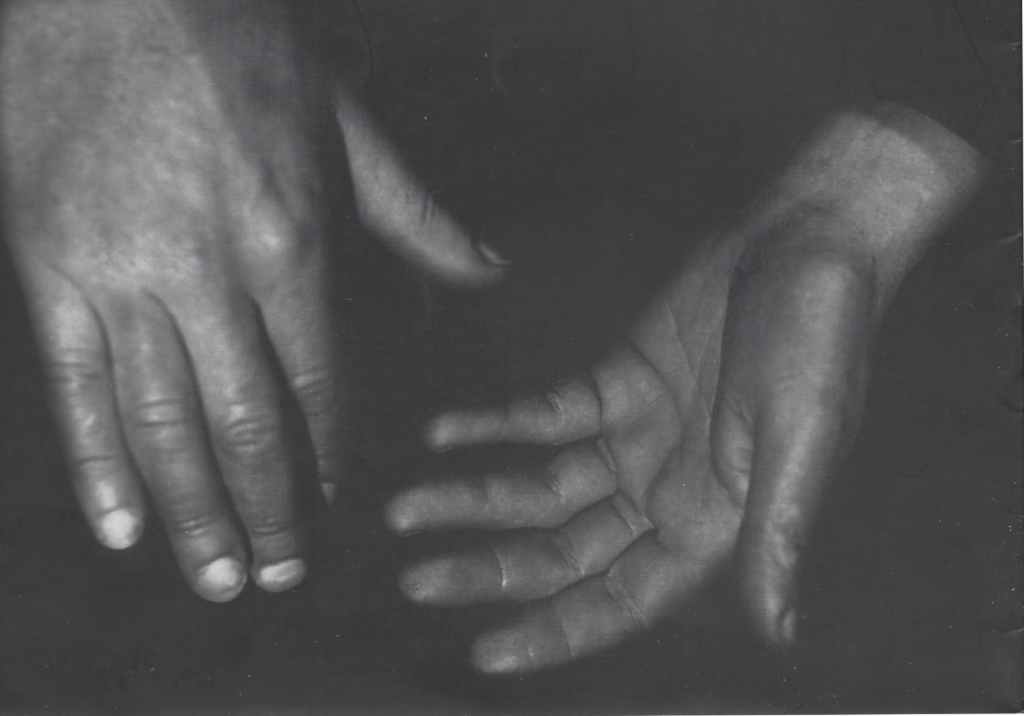
“It is no longer possible to believe that the politics of a poet is separate from the poetry – political biography is part of the text that the reader reads, it is part of the work.” Jena Osman, Feb. 5, 1995
Mandelstam wrote that “the revolution took away my biography.” You would like to amend his remark by writing that cultural Stalinism in the United States took away your biography, but Joseph Beuys intercedes in the voice of a Ukrainian or Russian (the difference was not marked in 1988) comrade in the party who reported trying to speak with Hejinian after a reading. “They think they’re important.” For 35 years you understood Sonja’s remark to mean much the same as Amnasan’s introduction to The Poet Killer. Now you understand the communist perception aligning her criticism: It is just as important for us to be unimportant. Why write, why even live, if you do not believe that your social and economic foundations will not find their organized expression in class struggle? Enough communists have been imprisoned, disappeared, or killed in the years leading up to the two world wars, not to forget manifold global repetitions of the same reaction, for the premise not to sound like a proof: fascist cadre are recruited from the ruined professional classes. Eliot wrote in Four Quartets something along the line of “twenty years largely wasted” entre les deux guerres. The statement issues from one whose work had already created a biography. The lesson, if there is one, is that writing for one’s time is a liability; Eliot, like a medieval pontiff, mistook Christianity for history. Jew-baiting would be the only passage Eliot could use from Langland. Before rhyme dominates the end of the line in English poetry, Piers Plowman can be found in court records misidentified as one of the leaders of the peasants’ revolt. There is no life of William Langland; no biography is possible since next to nothing is known, and next to nothing is known because the author lived and worked among those whose lives counted for nothing except their labor.
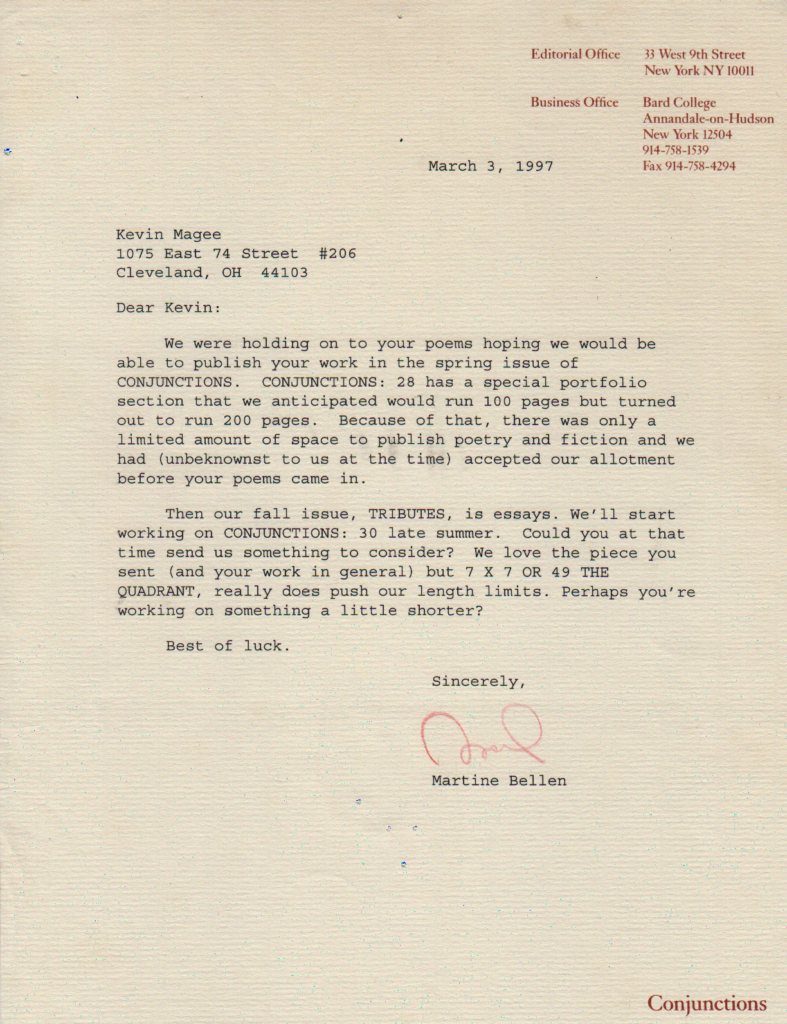
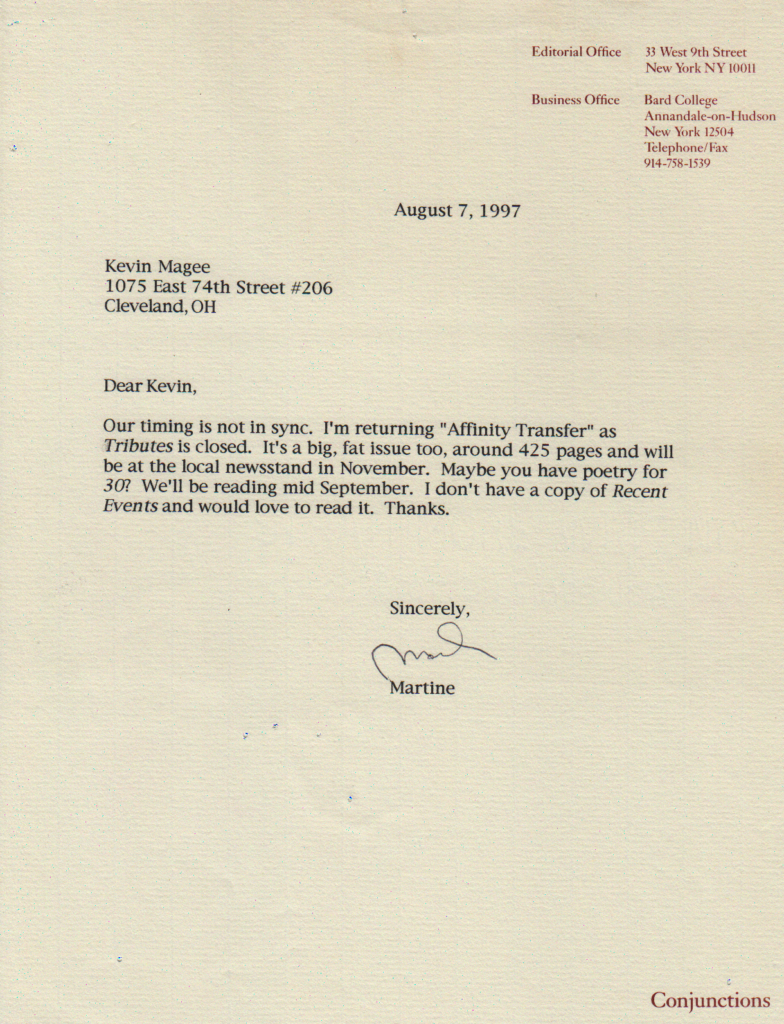
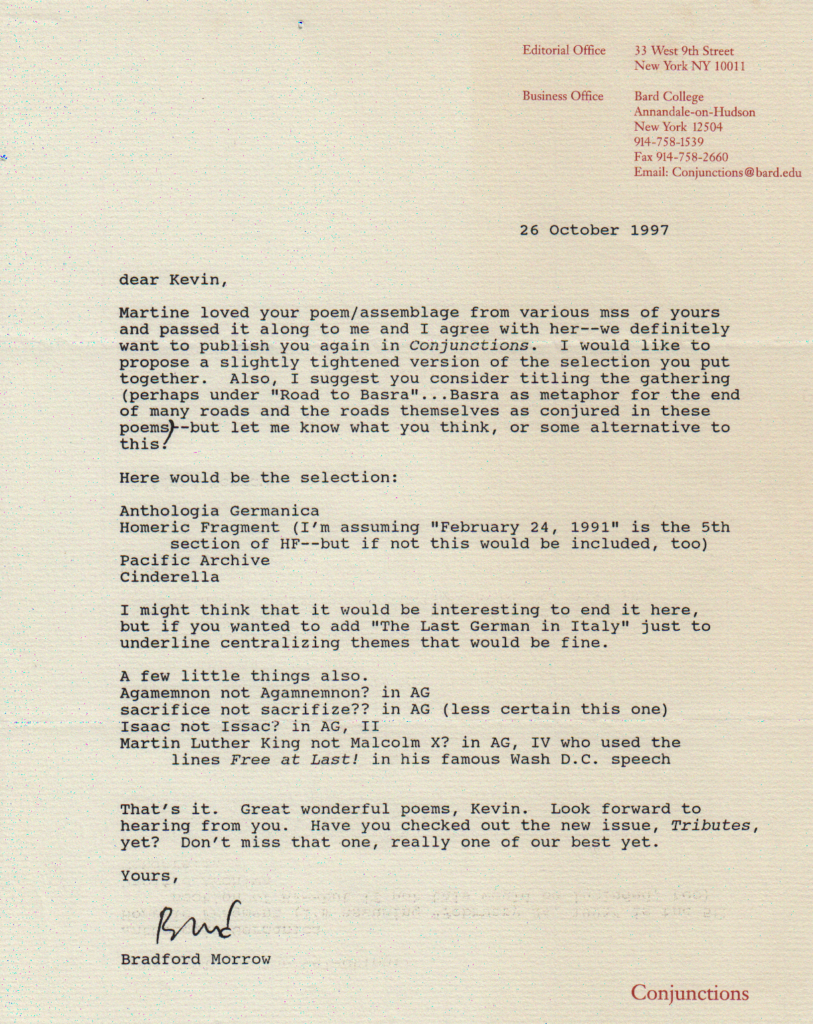
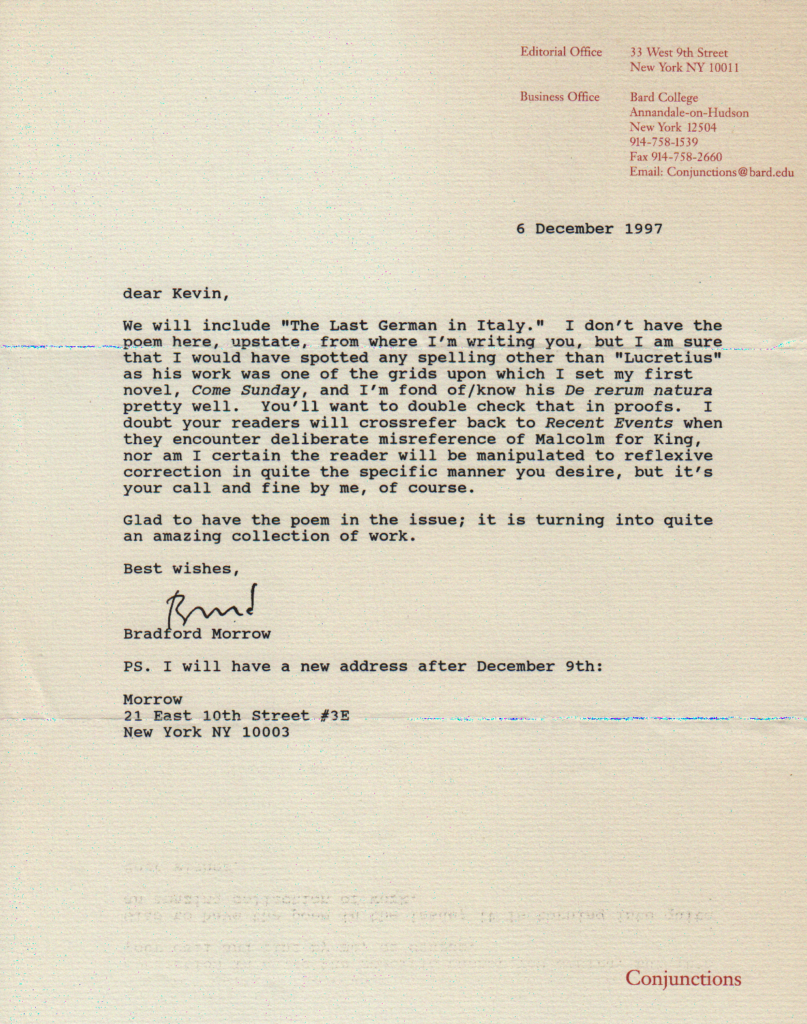
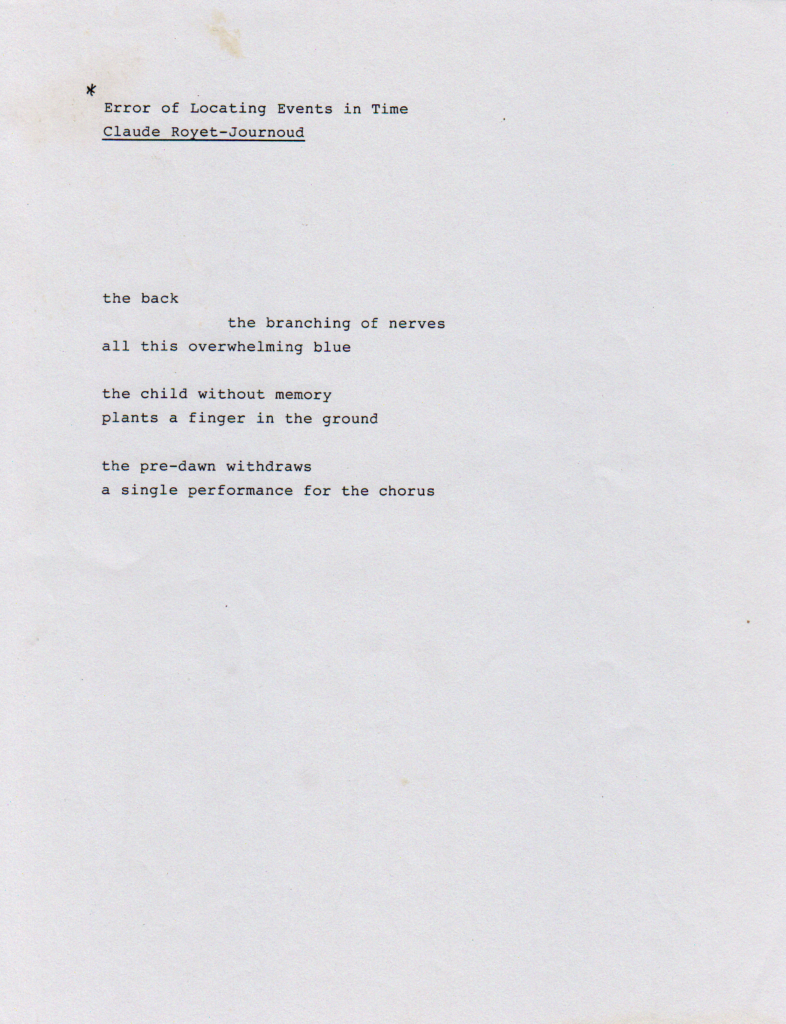
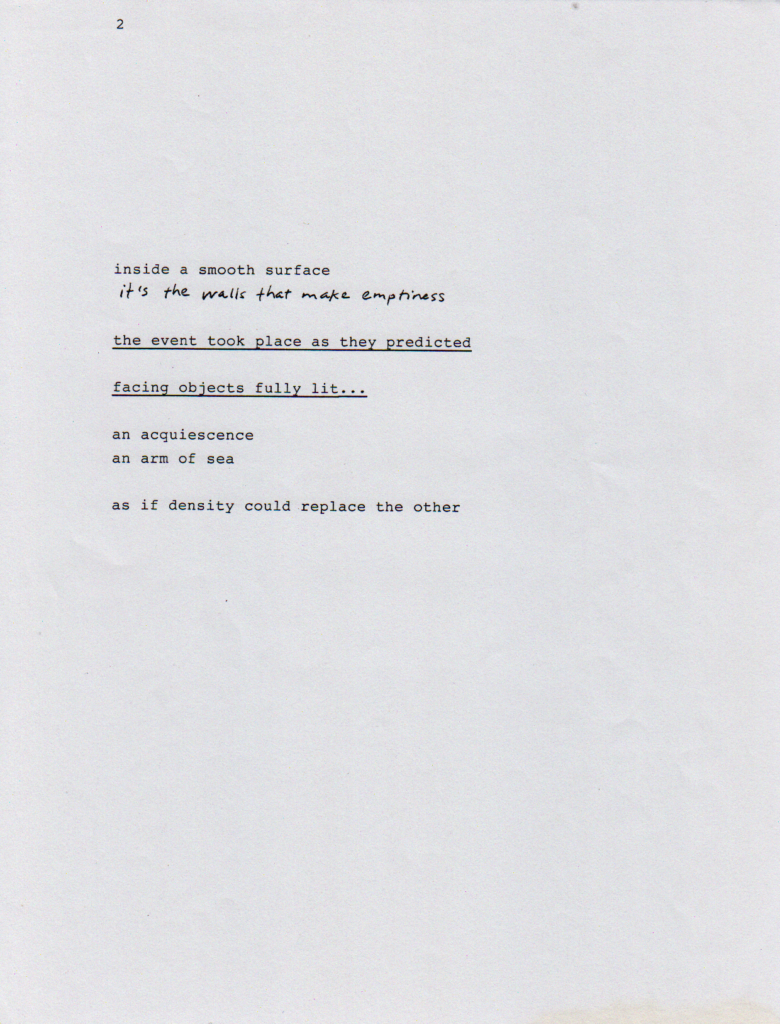
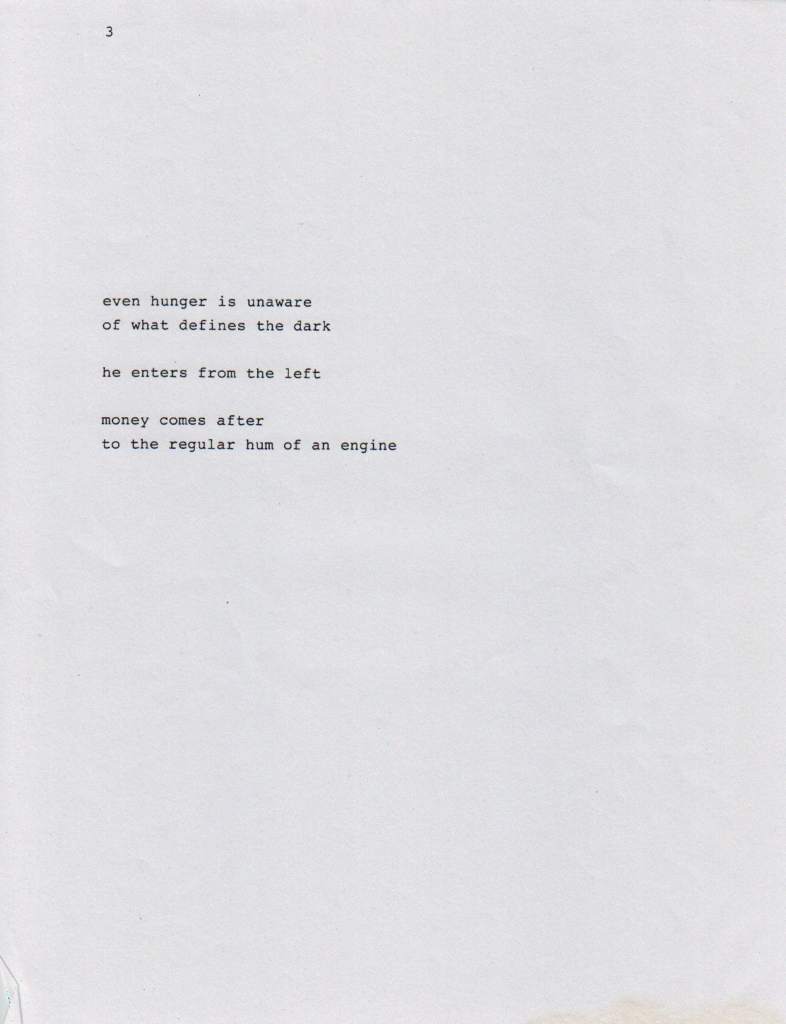
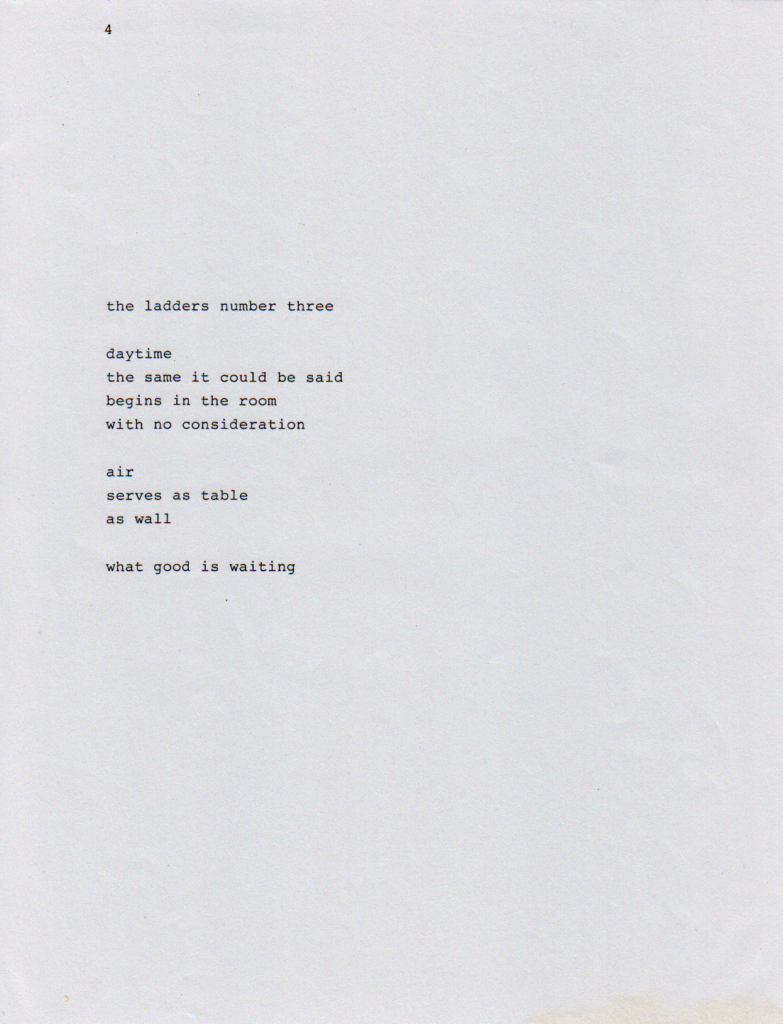
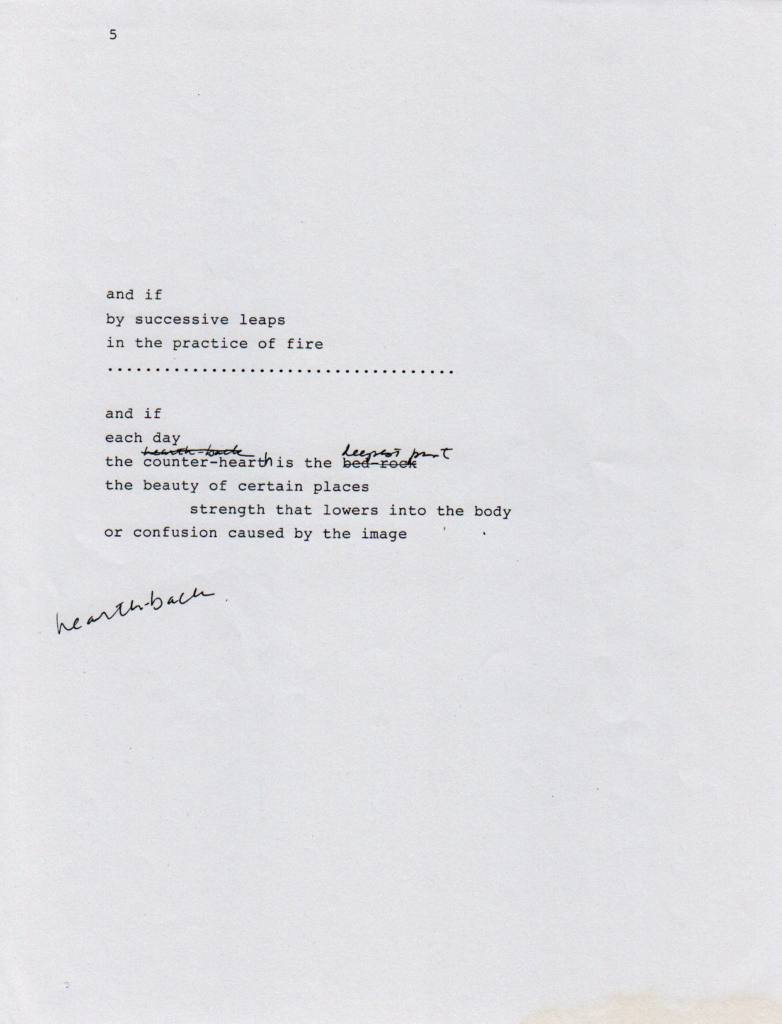
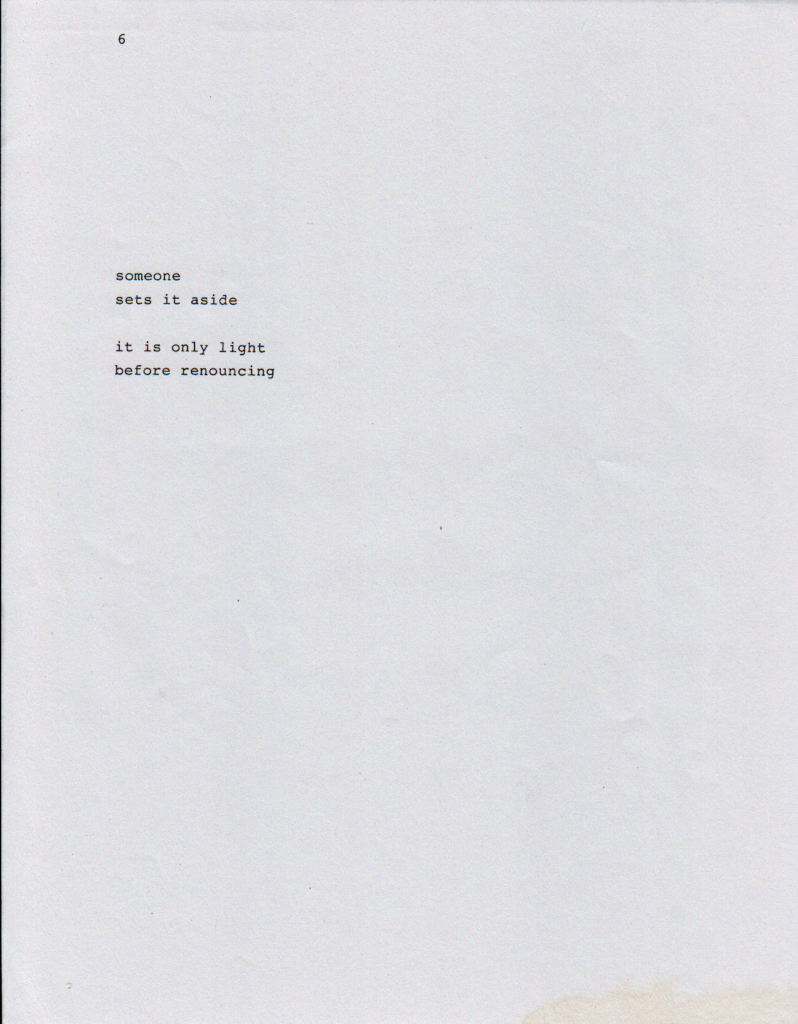
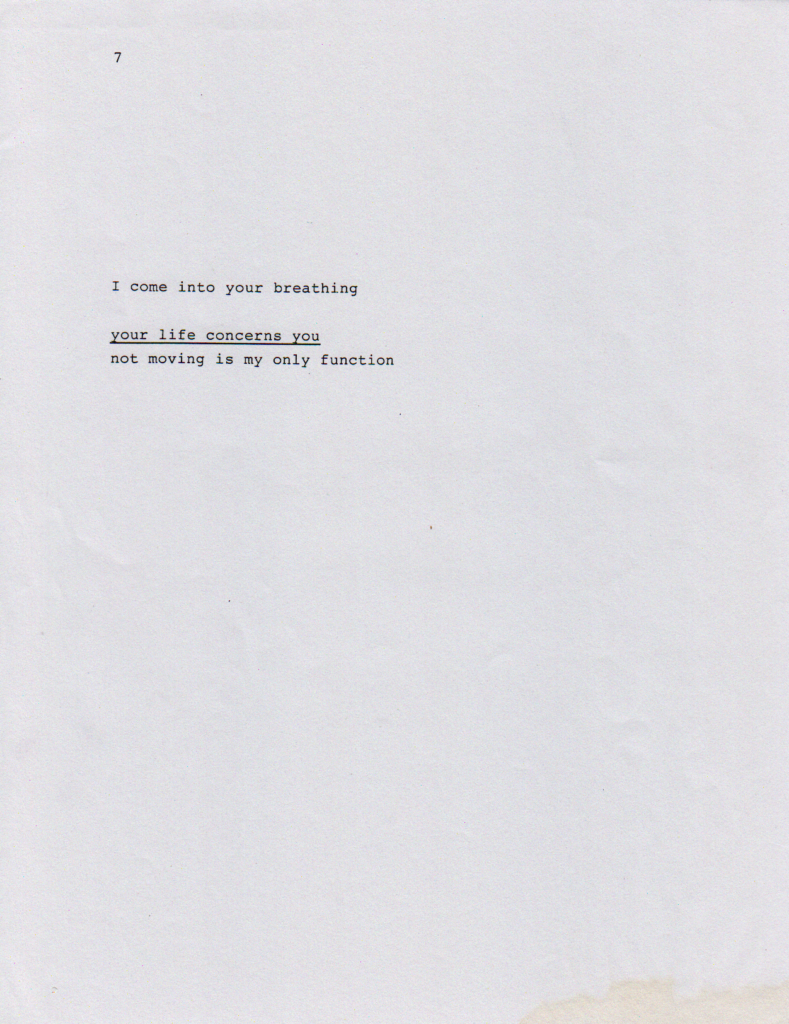
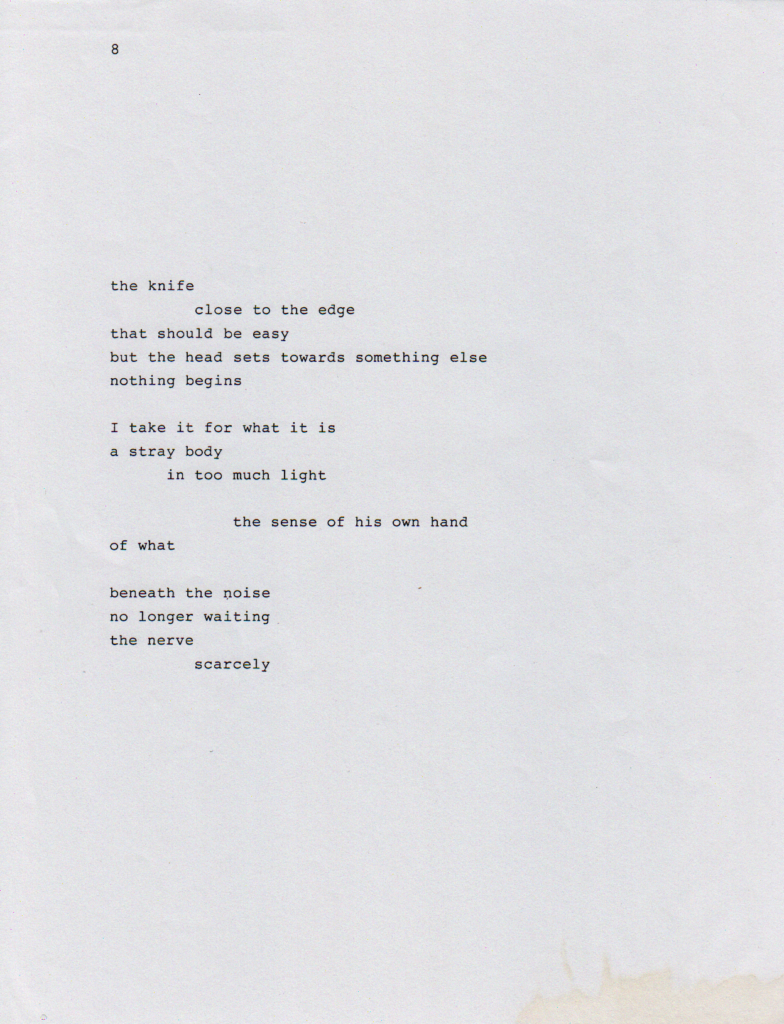
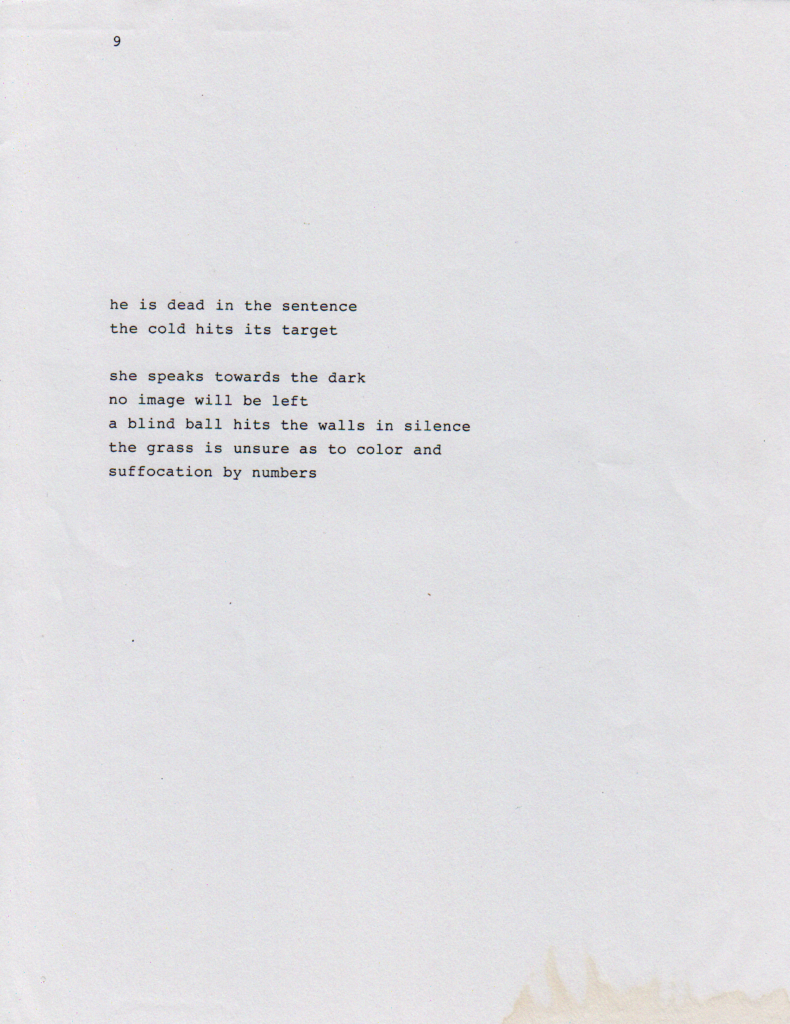
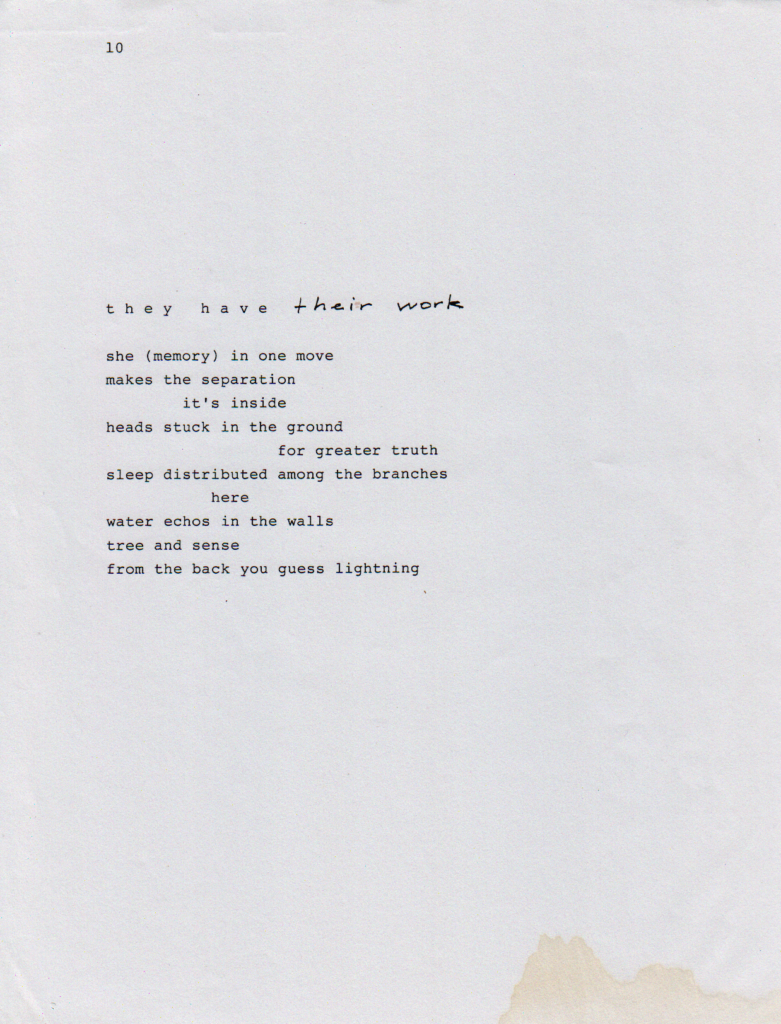
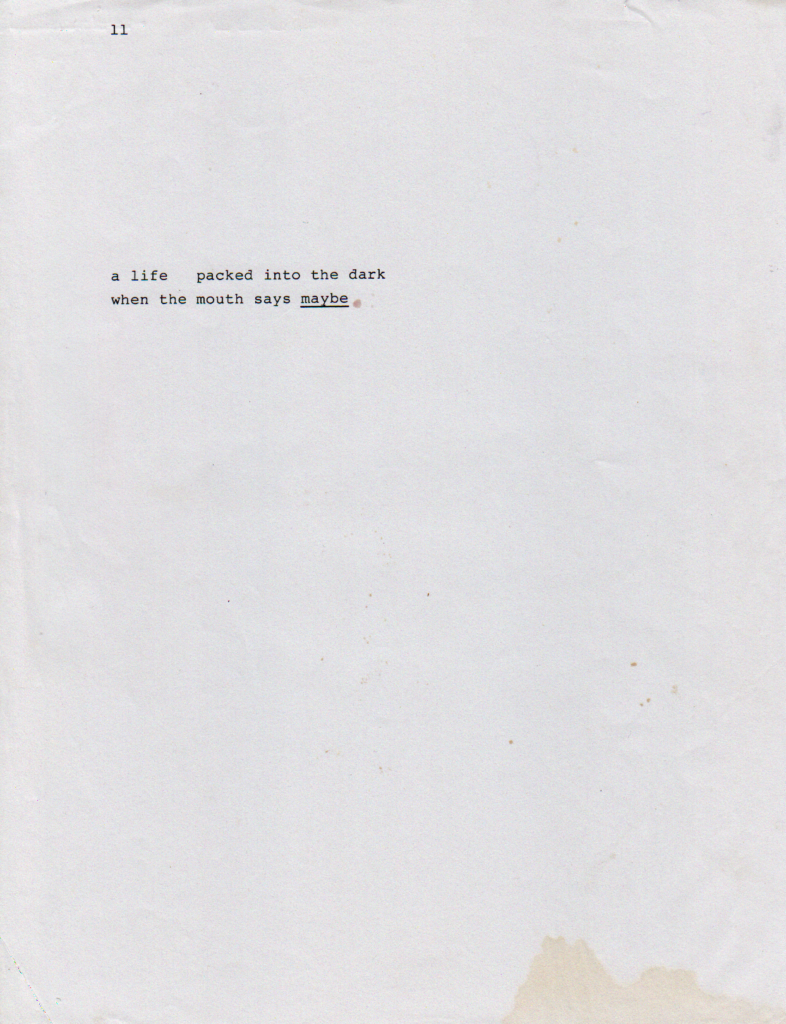
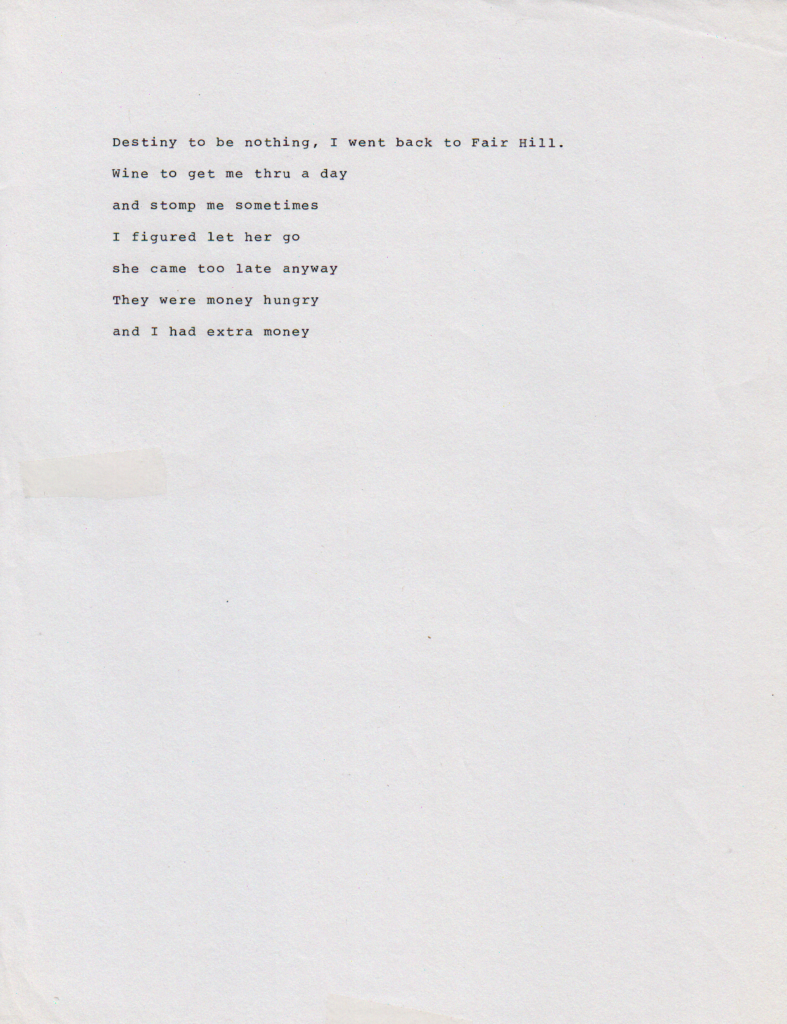
Poetry does not bear witness. Poetry does not commit mimesis. Art does not imitate life. Pages 1-11 foreshadow the privative form of Lullaby Alibi. In their privation – powerlessness – Error meets Zukofsky’s test of sincerity (a test of time few poems survive). Wittgenstein’s Letters to Thomas Carlyle’s Robert Burns (“now the tape please”) and Contrafact’s M for Moira read in comparison like a game of Gower’s Cat and Mouse. It is a question for philology, but the privative form (separation of art from life) may derive from facing pages in Recent Events:
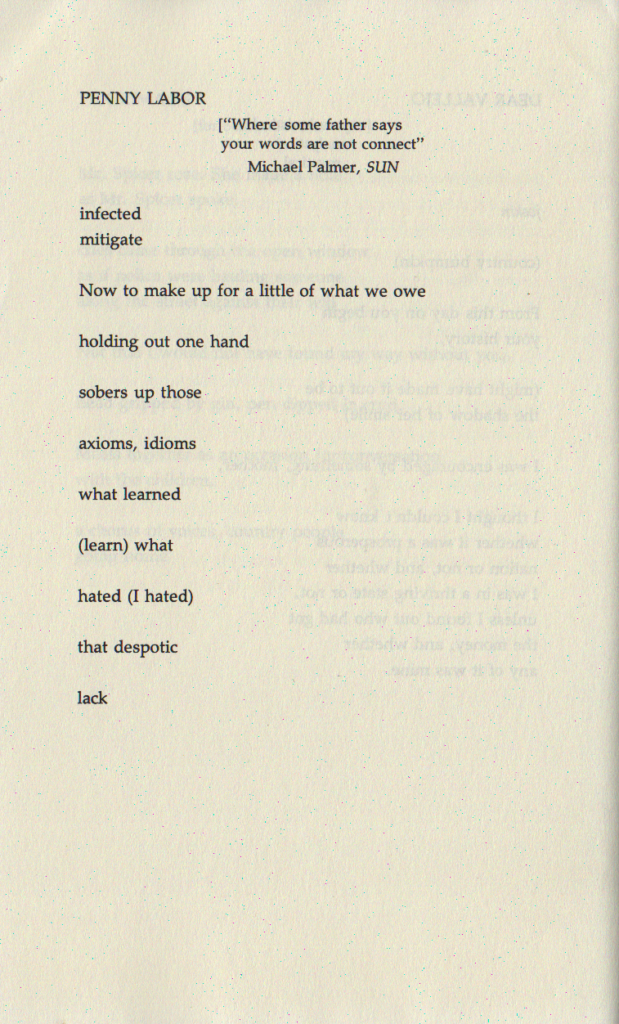
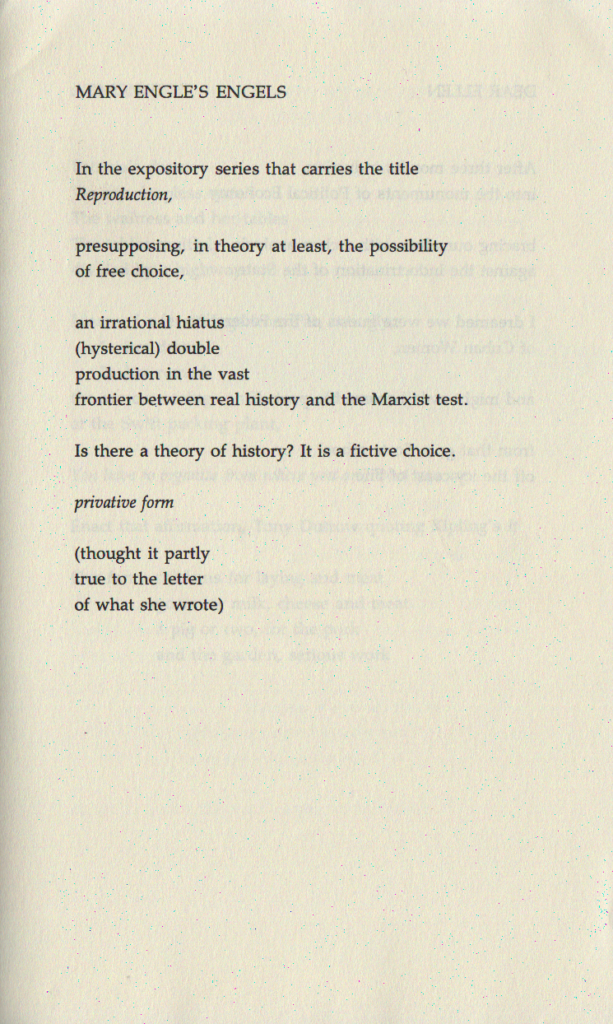
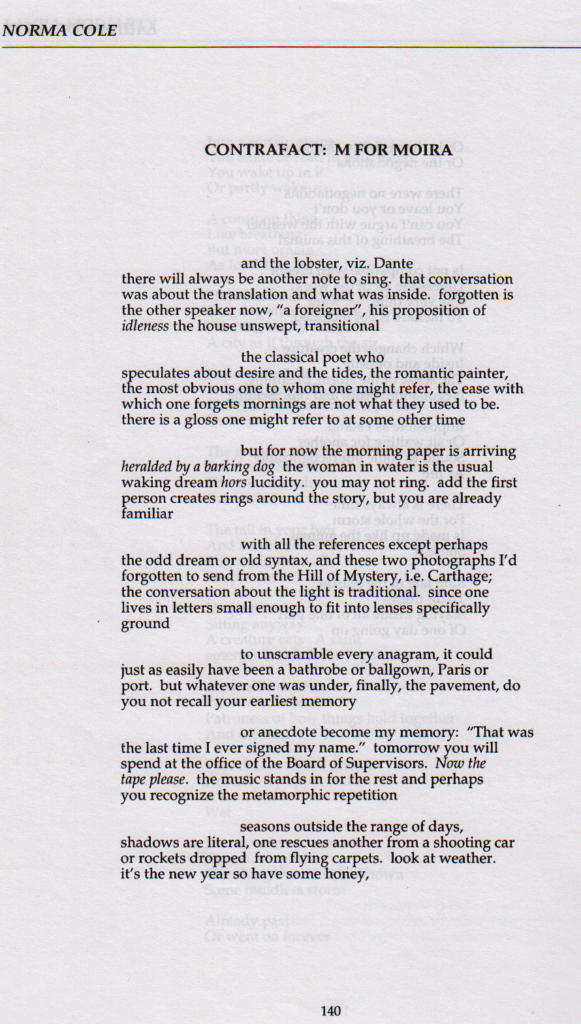
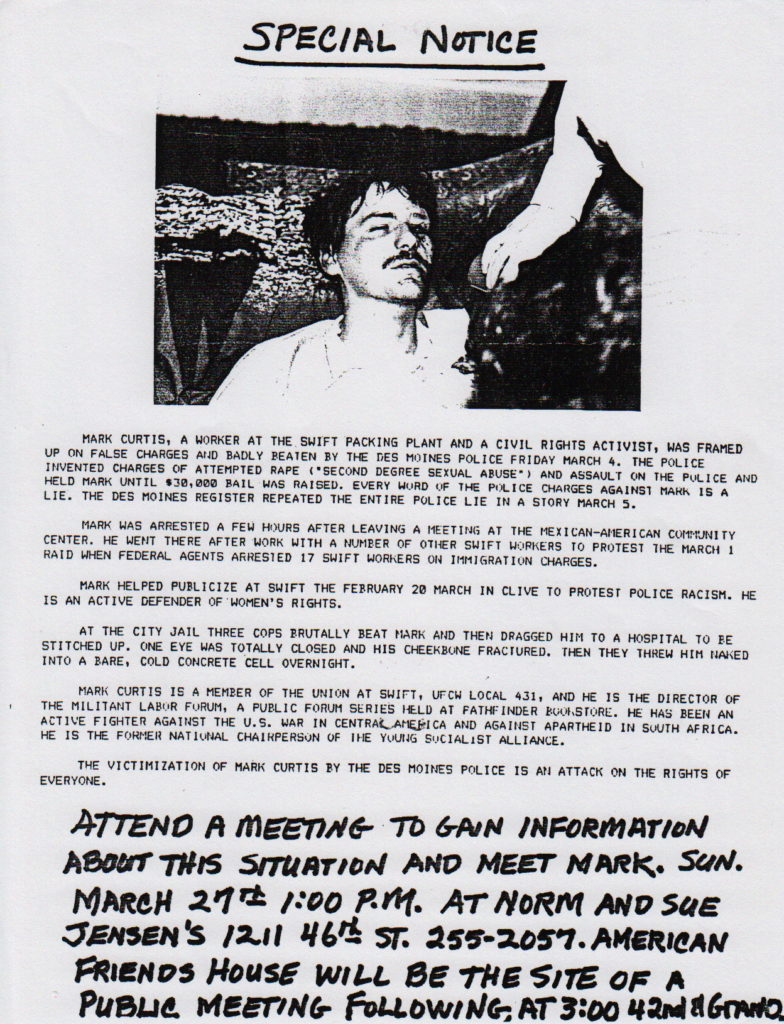
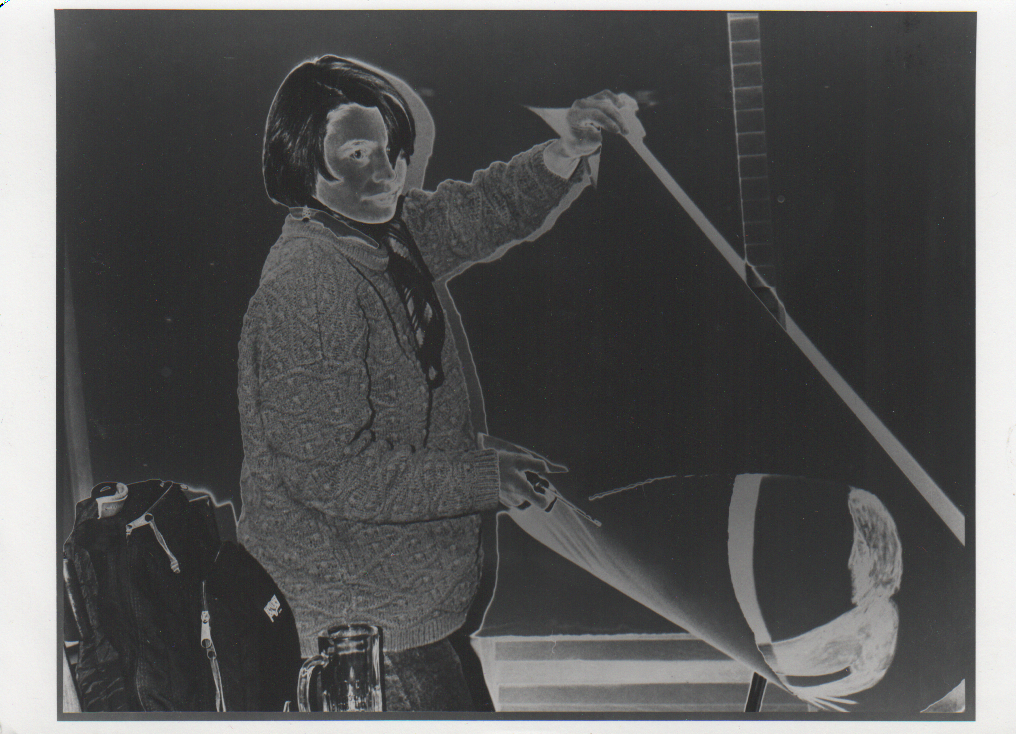
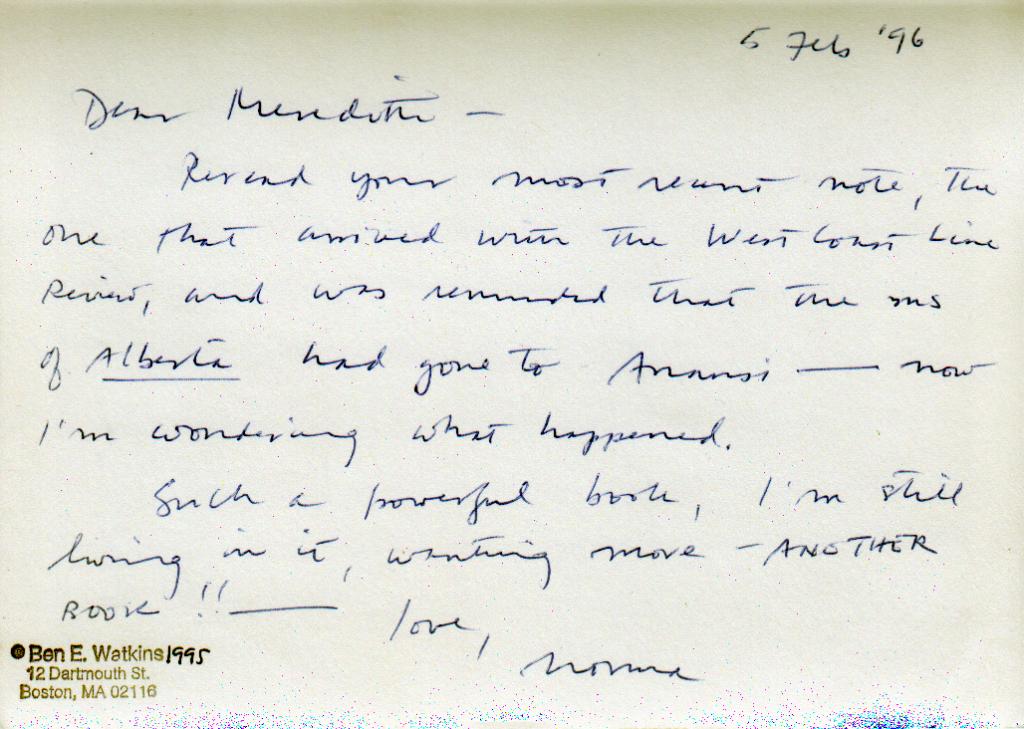
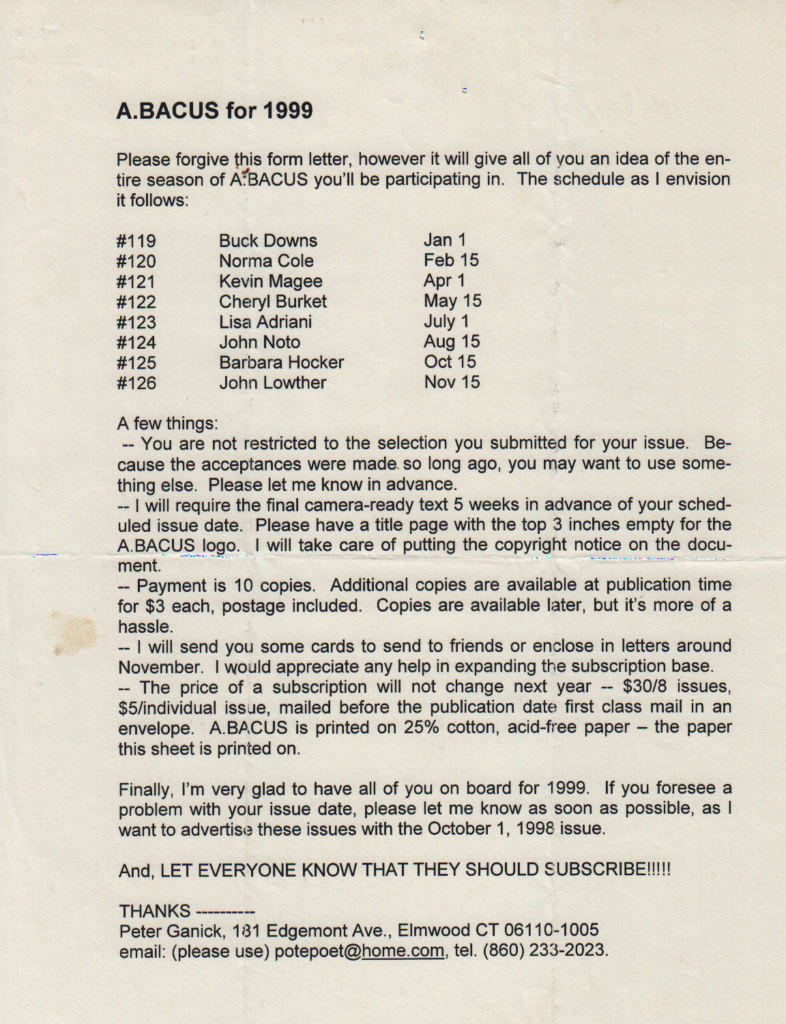
You did not know what to make of this postcard. It fell out of a hard-to-find copy of Contrafact, long out of print, ordered in the flurry of additions to your library after the summer of 2024. You did not know what to make of the difference in tone and the subject, sending manuscripts to publishers, which was never mentioned in letters or postcards or private conversation, all of which were soon to end shortly after the date on the postcard. Relief this morning that you remembered “new specs” accurately (end of p. 53), and you find this morning as well the detail of the phone call from Cleveland though the return call immediately after the conversation ended is either omitted or refracted through a thousand and one lines. The subject of a private conversation in person or by phone should never be reported in any form of autobiography. If you were ever to speak in public as a poet to other poets in the United States, you shoould insist on recording the conversation. Details from conversations that are overheard by a third person may, however, be reported even if you suspect the third person will deny the subject. A lesson from the Buffalo Poetics List. Fact: Only the 1994 issue of Avec, guest edited by the author of Contrafact, bears the title “Contrafact: M for Moira.” Contrafact (Potes and Poets 1996)(the title page from the Powells’ copy bears the penciled inscription: “To Meredith and Peter Q. with my best wishes,” signed with the initial n that, as always, looks like a cursive v, followed by “c”) prints “M for Moira” on facing pages with “Louise Labé.” The Selected Poems 1988-2008 (City Lights 2009) reprints “M for Moira” on pages 42-43. The poet in question, in severe question after publishing Alibi Lullaby in 2025 (an auspicious year that also sees the publication of Worlds in Conflict, The Additional Element of Architecture, and Homeland: The War on Terror in American Life). But there are two blanks _______ in “Spinoza in Her Youth,” the title poem, which first appeared as one of Handel Architects’ “meaningful adjacencies” in Abacus (Peter’s 1999 circular used to be on hypobololemaioi.com, but you remember the dedication to the Hungarian photographer). A German and Hungarian photographer form a surface of misdirection, which now appears as a mannerism. But “Spinoza in Her Youth” is not the poem where you remember reading that in another time, an earlier literary period, it was still possible to make one mistake. The mistake by the poet in question, in severe question, is not Alibi Lullaby. Even now, right now, you struggle to detect to the ruse, the provocation, the studied falsehood to draw you down from the mountains and participate in whatever remains of a democratic process. Was there ever anything resembling a democratic process, or private conversations among powerful bourgeois poets? Evidence of internalization abounds in the texts, like the blank ________ you forgot: “call Barbara, Amy, Evelyn, / Betty of all what you could know call Larry, Amy, ________, become the speaker of these eyeblue shoes” (69).
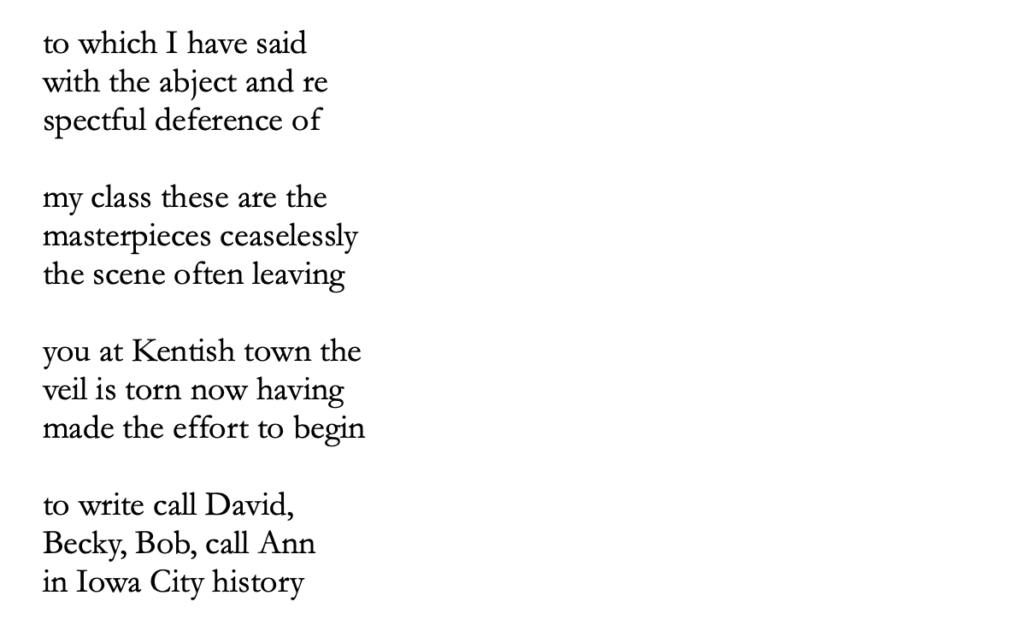
Internalization, write the architects in The Additional Element of Architecture, defines Malevich’s relation to the folk icon. That is not what you want to write. You want to write about the actual phone call, the one made by proxy, investigating a confidence penned in love letters once offered as evidence for a divorce trial. You are reporting a private conversation, but three people are implicated, although two will deny the conversation ever happened. Just as Howe will deny counting four thousand dollars after her SPT reading in front of the poet who needed a divorce lawyer. These are human flaws and forgivable. Quoting “That was the last time I ever signed my name” is an error of another order, a literary error, printed in three editions. Groys’ concluding criticism of the inquisitorial method of the non-dit can be applied to the unconscious of “M for Moira.” Groys’ objection to this method (also Timpanaro’s) is that it is psychoanalytical, and as such not only ideological, but totalitarian. Alibi Lullaby exposes the unconscious of “M for Moira.” You suspect, or imagine (did you learn the Vertovian cut from reading anyone else?), the thought first formed in the unconscious during the Tedium Drum meeting when the Mars manuscript, in 12pt Courier font, was brought out. The ghostly silhouette on the postcard to Meredith Quartermain had no way of knowing this. “You’re wearing his underwear!” (Arctic Summer, quoted from memory) was the local historian’s gloss on Contrafact. But that purse full of pens Leslie was lugging around the Salgado show was told for one reason or other during the first meeting at the dinner table around which five poets and one architect were seated. The problem with the totalitarian potential of psychoanalytic readings is that it only provides closure for the inquisitor, the analyst, who bears down on the letters in a text at the expense of the question from Geoff Waite about deconstruction’s willful blindness to historicity that Jonathan Culler refused to answer. Did he say “I’m not going to go there” or “I’m not going to let you take me there?” Deconstruction was doxa in the 1980s, like the text’s non-dit for the 1995 “fake book.” That is the last time you will ever sign your name.
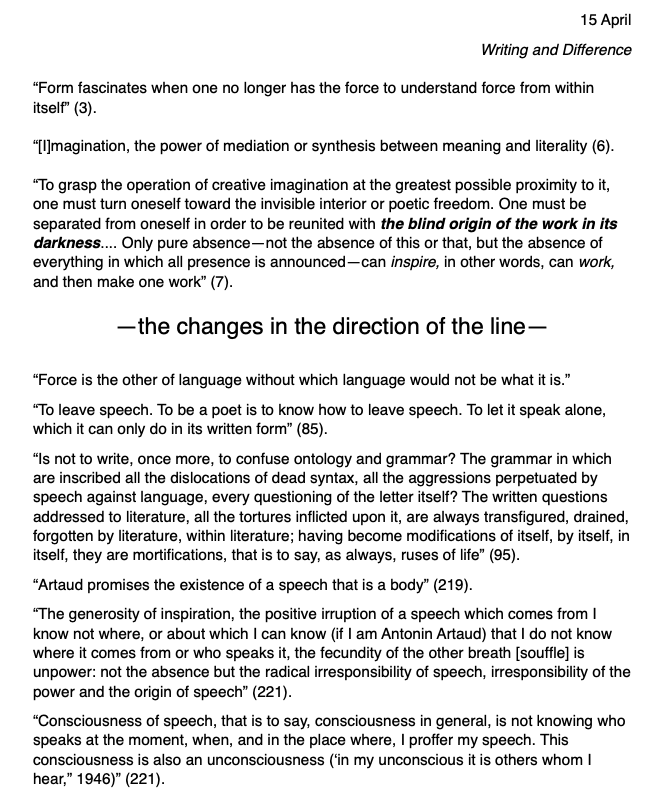
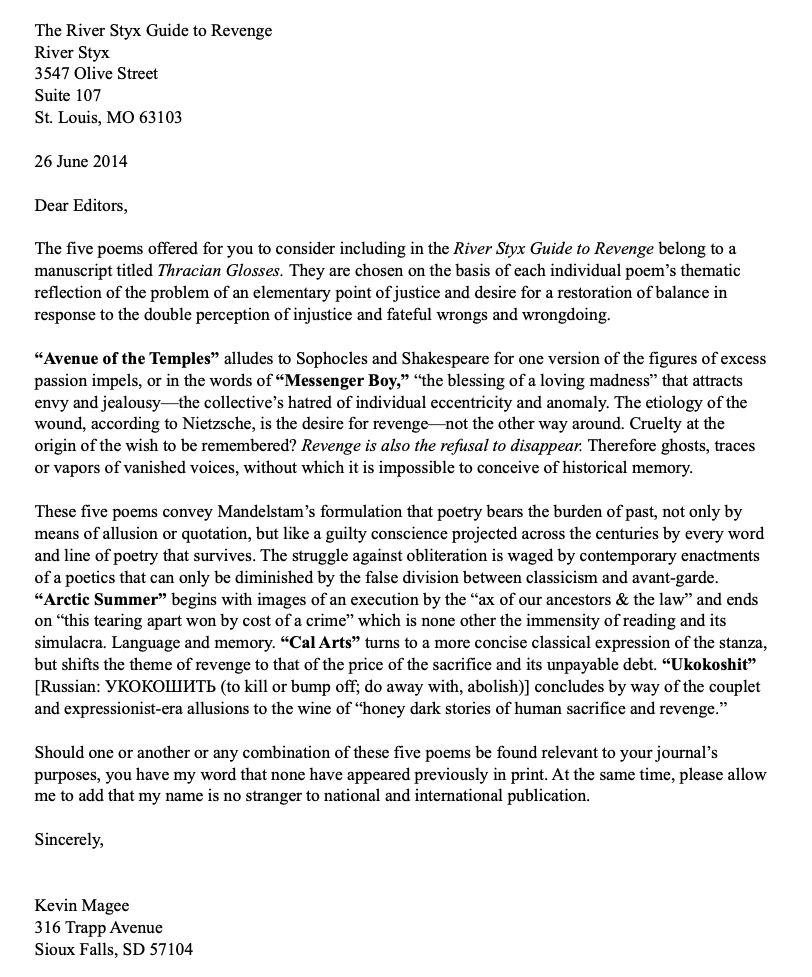
The poems were returned. Robinson should remember the conversation at Howe’s table about the Vancouver editor who rejected her submission with a patronizing letter. Howe said something to the effect that after you publish a book your poems should not be sent back. After 2007 and the publication in TCR of “to write as speech,” “Euphorion” and “Balance of a Happy Day” in Conjunctions 48 and “Work Song” on Conjunctions’ website, no one would publish you. All three publications happened from Poland. After returning to the United States, no one would publish you. Only when you discovered in Nightboat’s Writers Who Love Too Much that the date for circulating the Apex of the M letter had been moved to 2000 did you begin to suspect, or imagine, the error of “Error of Locating Events in Time.” Roy mentions the 1995 El Cerrito open houses on her blog in 2008. It is still online. The source for the information is the author of Arctic Summer.
August 22 1999
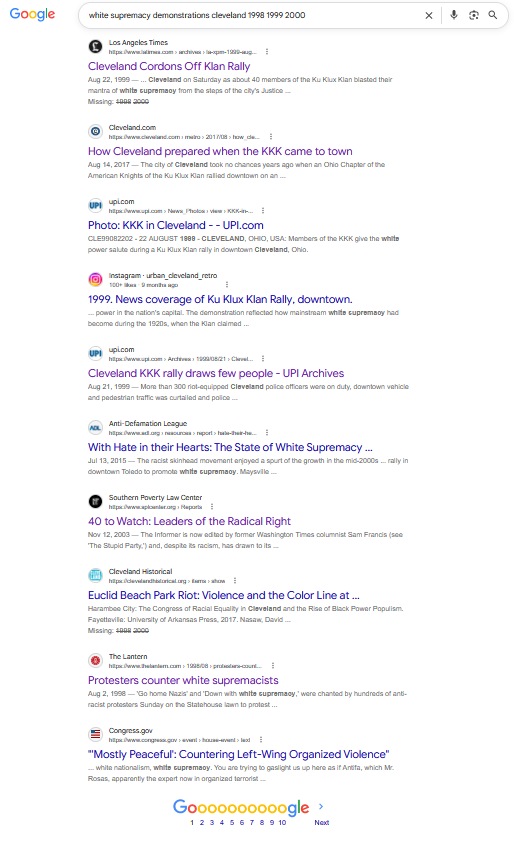
Eva wasn’t at the bookstore on the afternoon of August 22, 1999, for her presence would have altered the surprise of the others for the visitor who just happened by during the Klu Klux Klan demonstration downtown. You were keeping company with two, maybe three comrades, biding time, staffing the bookstore into which passersby rarely stepped for the practical reason that the bookstore was not a business and did not keep regular hours. The visitor expressed an open curiosity about the books on the shelves and the politics their titles represented. Eventually, a circle formed, so there were at least four, maybe five, including the representative of a Kurdish-support organization, which is how she identified herself when the question finally arose as it so often does, almost naturally if not good naturedly, What is your affiliation? (Implied: Are you speaking for yourself or for a group?) Maybe she bought a book or two, but her visit lasted almost an hour, longer than the demonstration downtown that the city newspaper had built up, more than likely not all on its own.
Can this memory be verified without photographs? It’s even unlikely that anyone in the Cleveland bookstore is still active in the party – comrades burn out quickly, or move into other groups, or settle down in the security of their trade-union jobs like Bob and Ellen some years before. Neither is it unlikely that a report exists in the party’s archives, especially since one of the comrades present during the visit of the representative of a Kurdish-support organization (international, she had said) spoke in rather critical terms of party culture and the level of discussion at a regional mass meeting weeks later, and was reassigned to a distant place, maybe Texas. Your name may even be mentioned in someone’s report. Nobody said as much or anything so dramatic as a guard detail, but it was also clear that you were not welcome to leave. Fair enough. For as many times that you had been made to feel welcome at a Pathfinder Bookstore.
July 28, 1999 Oberlin
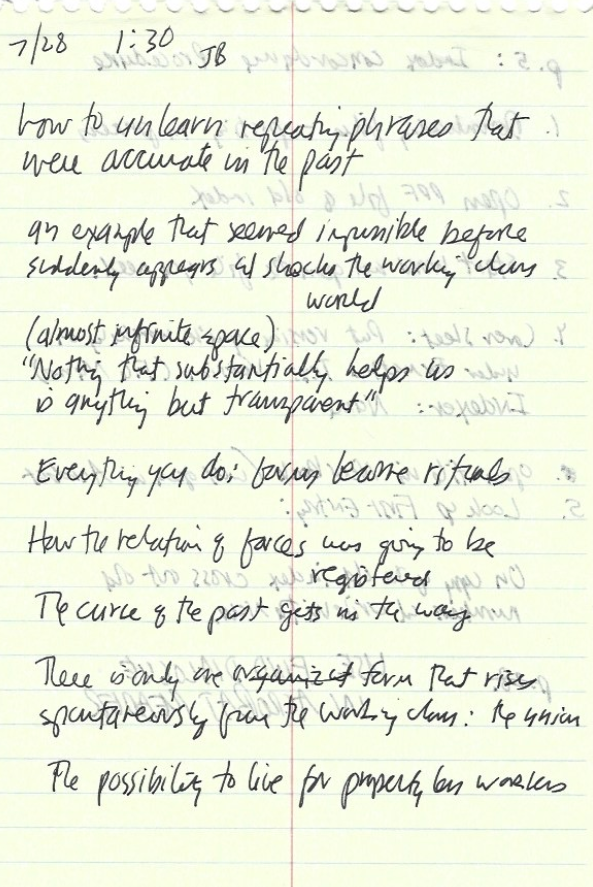
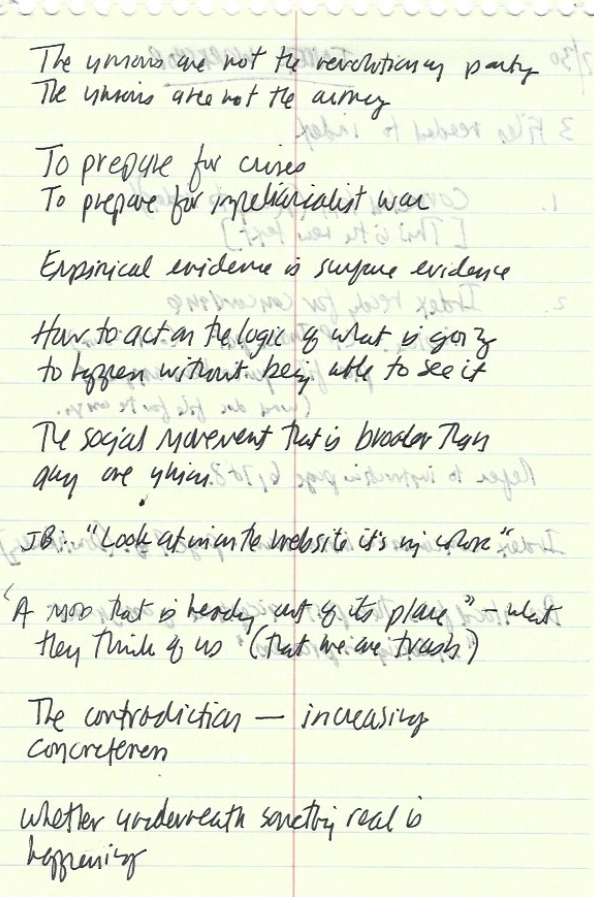
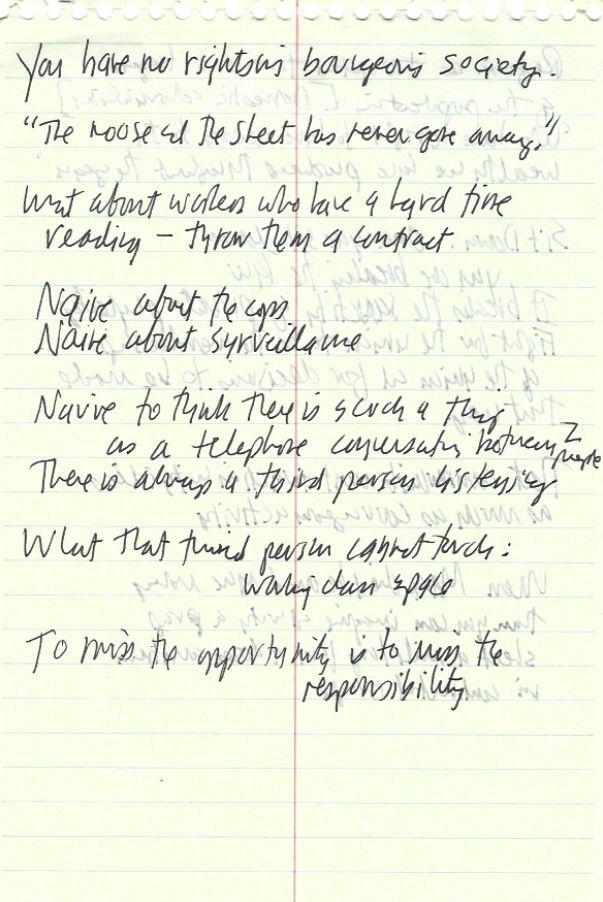
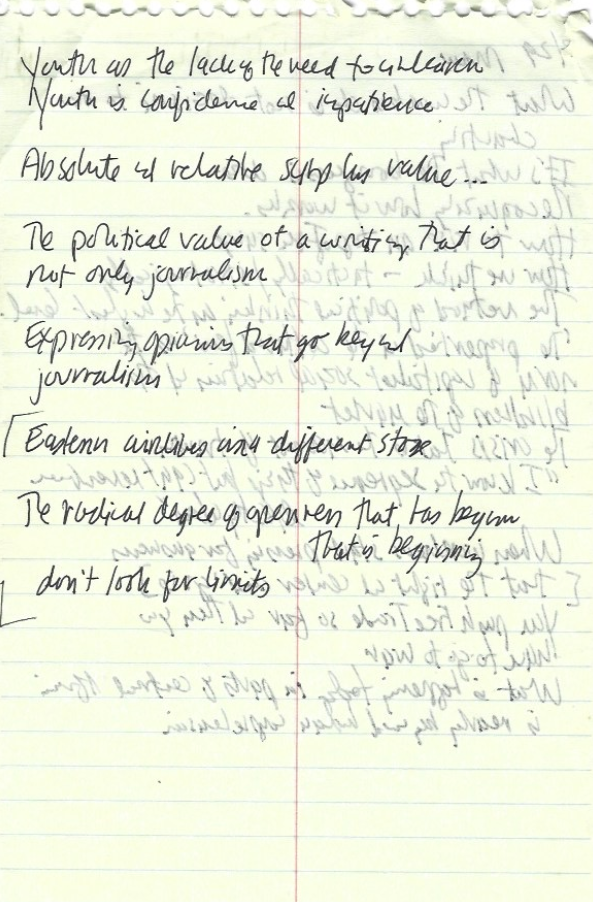
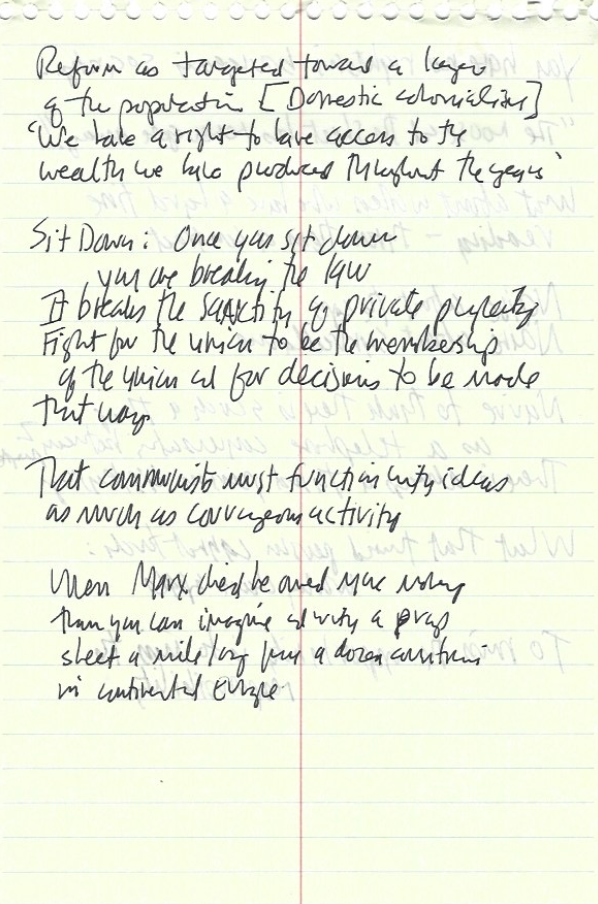
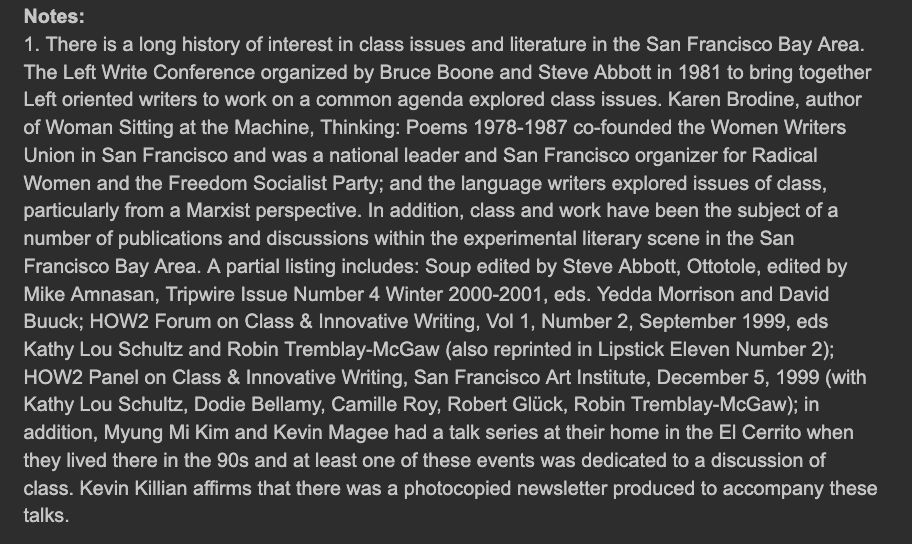
The problem with locating events in time begins here. These notes from a page in the Isik notebook suggest why: <<Images – cut / psychoanalysis – memory never preserves the past – not the recovery of complete past – traditional theories of cultural memory: image – image > cut>> The speaker, it turned out, took the same seminar at Cornell with Geoff Waite as you in Iowa City. Memory never preserves the past. What is left to narrate? Barrett Watten’s nine pages purporting to represent ‘a day in the life’ of the Buffalo Poetics List is one of many such research narratives to which is addressed the error of locating events in time. Watten’s error in these nine pages is different from the error of omitting from The Constructivist Moment (Wesleyan 2003) Groys’ widely reviewed The Total Art of Stalinism published by Princeton in 1992. That error, among many others in the waning generation of so-called ‘language’ professor-poets and their demotic new narrative double, needs to be theorized if the charge of cultural stalinism in the United States can hold its ground. One of the links to this proposition is your participation on the Buffalo Poetics List beginning in 1998 (you were lead there or lured there by proxy; you did not join the List). Who calls anyone out of the blue whom you have met only once before to encourage you to join something called the Buffalo Poetics List? (Diifficult to remember a time when you accepted the possibility that you were a public person, what either innocents or fools, or preternaturally acclimated careerists, care call a “name.”) Through a chain of events impossible to reconstruct – again, the error of locating events in time – posting to the Buffalo Poetics List led to that afternoon in the Pathfinder Bookstore in Cleveland on August 22 1999.
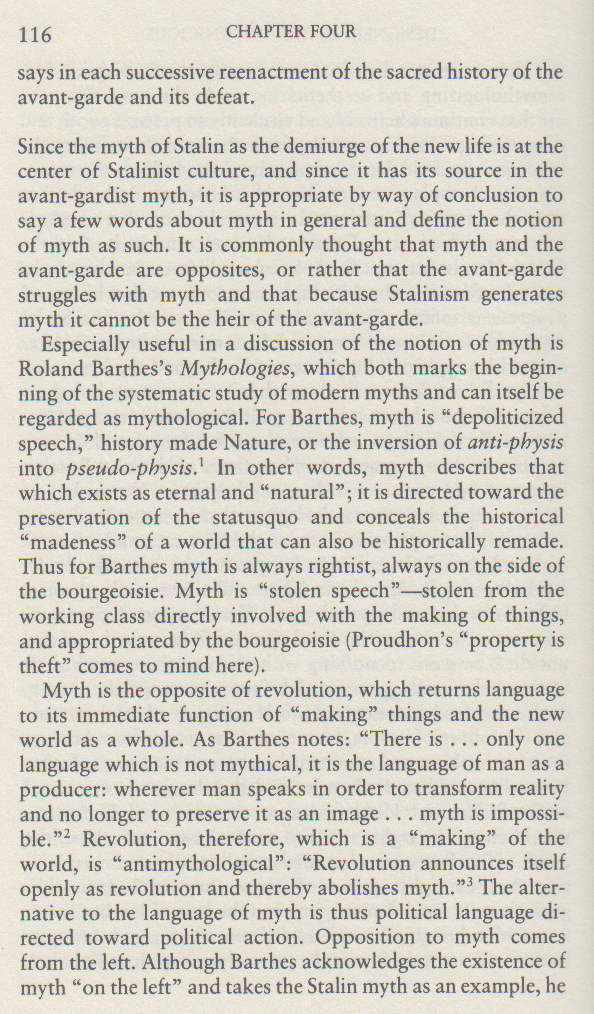
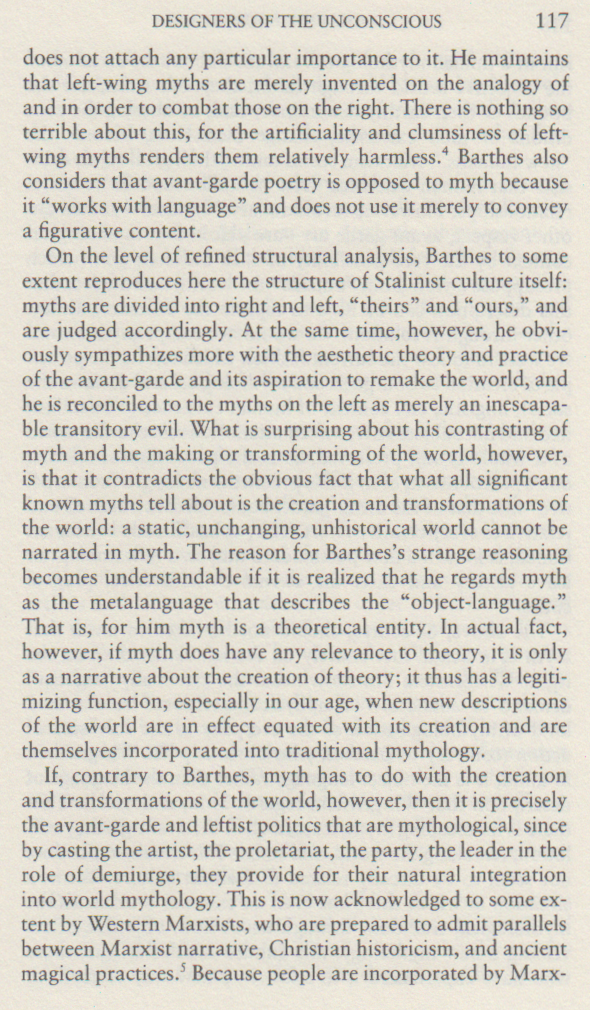
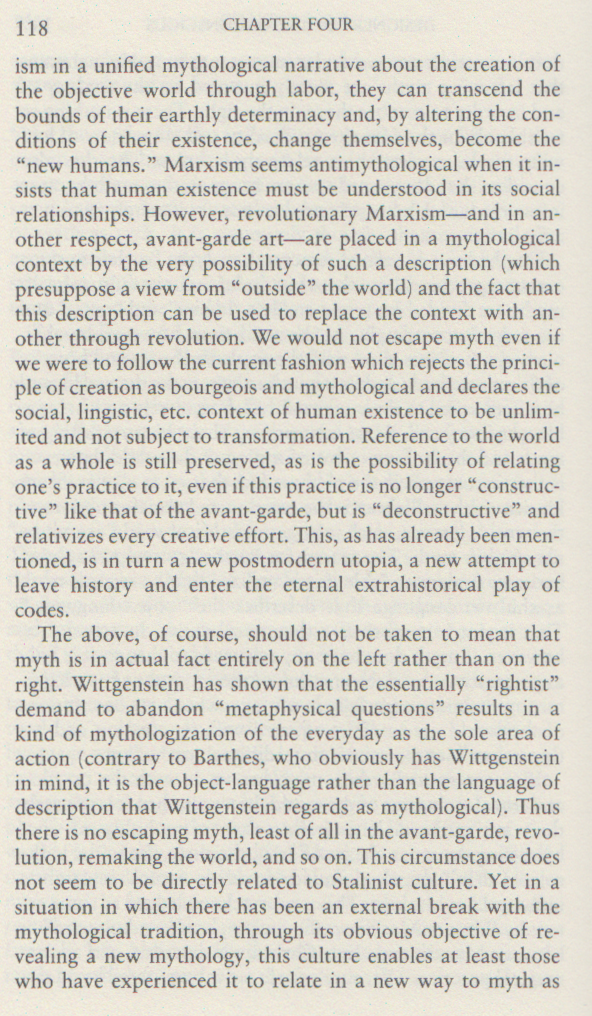
Blasphemy? Has no one from the 90s listservs come forward to attest to the pranks, network practices, exposures, dumping “private” emails in public view, or worse, or trite reminders of rising university supervision of American poetics in the overhearing (as was told to you) of Perloff saying, loudly, “I’ll get them” at a party about a poet who wrote something unfavorably about her. Damon backchanneled you about the anti-semitism accusation, but backed off your cite to Badiou and your overture for her to forward the exchange to the list. All the emails melted, just as Instagrams all but evaporate in the moment. No one is accountable, and anyone can be everyone: swarm, mob, impersonate,harrass, shame, accuse and arouse. Groys wrote about it happening in another, slower form a century ago. Quoted in full somewhere on one of your pages is an Eastern European commenting on the online strategies of people in positions of power, technological power, invested in making sure that nothing happens that threatens either their position or their power. What place of power – not person, especially not an individual – but what seat of cultural power was served by the plot to firebomb the East 74th Street lofts? Where was the camera you took to Harlem, that 1960s’ Canon FT left behind in Chita?
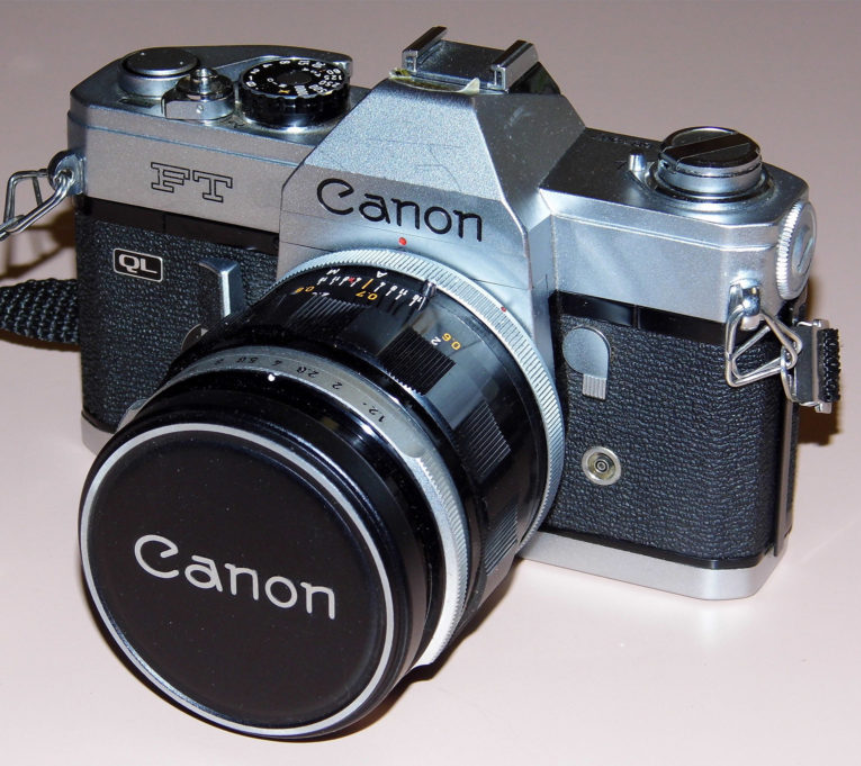
The used price of $200 in 1976, equivalent today to the price of a pre-owned Macbook Pro, was asked by an ex-GI who’d brought the camera back from Japan. Like many community college instructors of that era, you learned how to use it from a gruff, practical photo-journalist who spared no one in his review of the mounted portfolios at the end of the semester. But he approved of the FT, heavy, almost unbreakable. The weight helped to compose the shot; the Pentax K1000 is closest in kind. The lever for advancing to the next shot is loud and slow. Compared to Instagram, were the late-90s mailing lists like those early cameras that shipped with a light meter? Without the light meter, you had to study the light for the best measure between speed and exposure, f-stop and lense. Even now, you know when you are in a bright 1000 or 500 and 16 or low or waning light of 60 or 30 and between 8 and 4 or lower. Harsh glares in a summer sun turn into evening shadows. The light meter was like writing something on a keyboard and pressing send compared to pen on paper, envelope, postage. Handwritten letters and postcards addressed to one person mostly, and never more than two, and you always knew to whom you were writing. The lightness of digital cameras, not to mention phones, subordinate eye to image. You don’t have to worry about the cost of the film. Just shoot and keep shooting and something will happen. A composed, coherent still happens all but by accident.
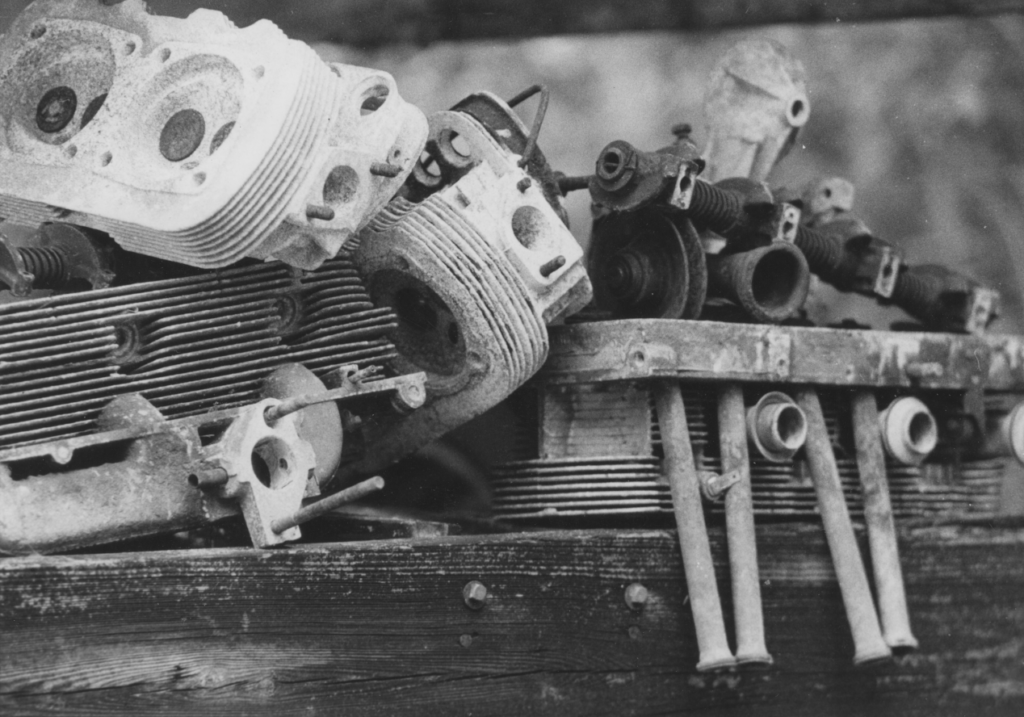
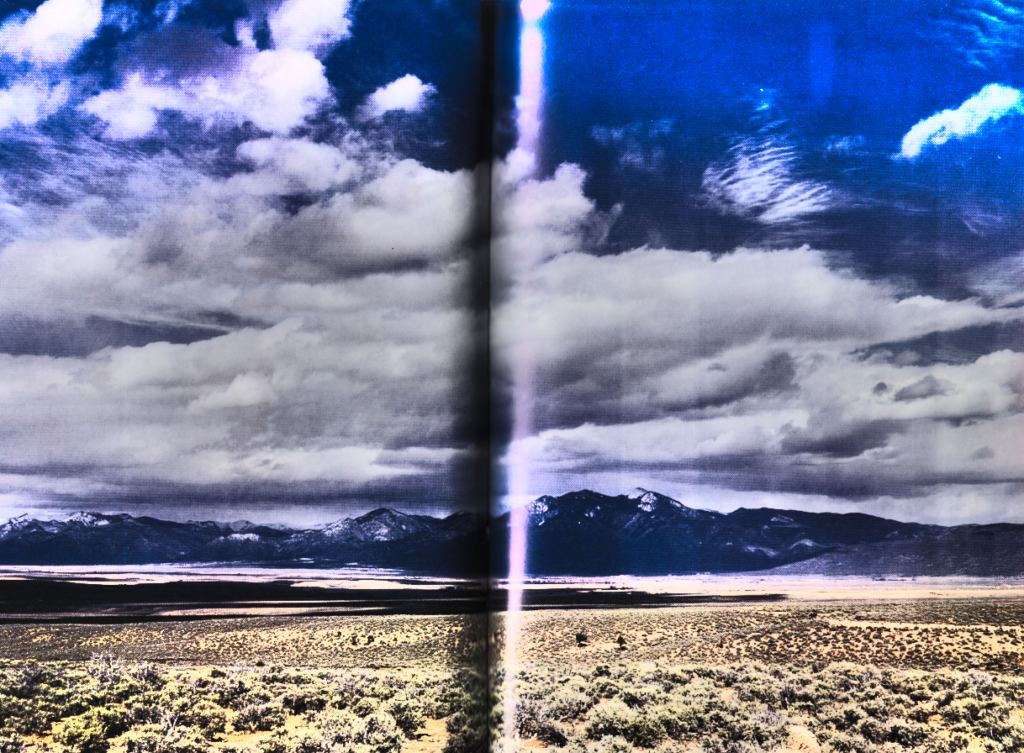
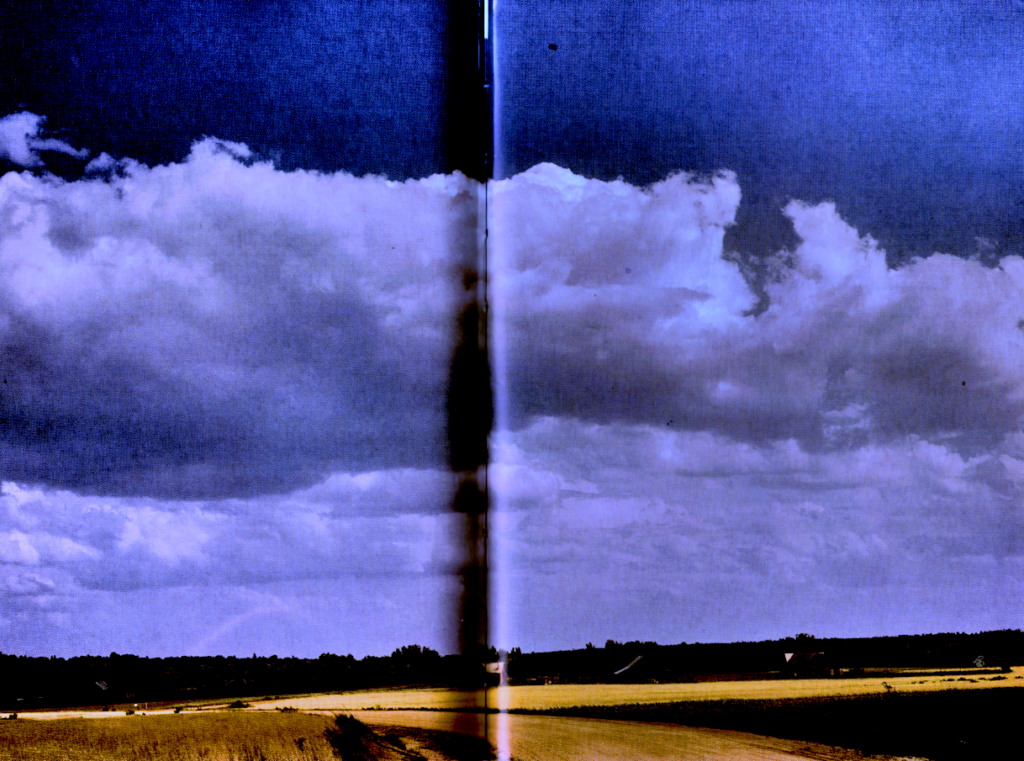
The only surviving print or negative from the community college photography class. Backyard. Hiatus Road, Plantation Acres, 1975. The instructor would have criticized the white area on the upper left, an easy fix in the darkroom. Imaging software offers a wilderness of enhancements that obliterate the simple issue of detail. The problem with the unburned area is that the edges to the object are erased, so this area in the photograph competes with the blurred focal point. Where is it? The lower-left bolt on the beam or the pulley slightly center right? Writing about it, the memory of the shot almost surfaces after more than fifty years. The instructor’s criticism may have even discouraged taking further courses. How old were your glasses? Even now, you only update your prescription every five years, so the field of vision is often out of focus. You do not read with your glasses. The self-satisfying uncture of (unctuous, hypocritical, insincere, glib, smooth) “new specs” (quoted from memory) in Spinoza in Her Youth. The class privilege that leaks from adjective and Mrs. Dalloway noun. Far more offensive than the blank ___________ for the signature that no one dared name. Note the metonymic repetition of Blaser’s “so-and-so.” Alenka Zupancic’s keynote address in Louisville, Saturday, February 24, 2007, in the Elaine Chao Auditorium, 3:15 p.m: “The Surprise of Repetition.” Zupancic talked about Chaplin’s The Great Dictator and the problem of cheerfulness, as in American optimism. Mladen Dolar’s “The Voice and the Stone: From Hegel to Beckett” was more lyrical and pleasing to your ear. Almost twenty years later, call it political instinct, or Kantian intuition, but fascism is not the gravest threat to the future of Europe and America. Groys is signaling the danger in the closing pages of The Total Art of Stalinism, his Western debut in German, not English. SOTS art was not serious enough although Kabakov, like Groys, separated Malevich from the Russian avant-garde. Cultural stalinism revises history to its advantage. Worse, Groys begins to connect Lacan and Deleuze to Soviet psychiatry’s ideological behavior modification. Below are two illustrations of bars to subjectivity, scans doctored in the open software darkroom. Library of Congress, Farm Security Administration archives. Popular Front days. George Oppen, totalitarian icon, goes to war. Whose idea was it, Brecht’s or Berlau’s, to make Kattrin mute? Silence is the effect of unspeakable psychological violence, then as as now, in a world at war.
What are the outlines of the National Question for World Literature? If the origin of national literary studies can be attributed to the generation following the French Revolution, a development that in English is associated with Coleridge’s Biographia Literaria, two centuries later, the logic of history neither dictates nor determines but should indicate end points to the fiction that the cultural fields called American or British or French or German literature can continue to perpetuate themselves with impunity. The task of dismantling nationalist literary studies falls on postcolonialism, whose founding error was multiculturalism or ethno-national accommodations to institutions of scholarship and research that, forged from the ascent of colonial empires, must either recognize the historical infamy of their structures of study, or accept their irrelevance. Just as classes refuse to surrender their economic and symbolic power during times of crisis, the social layers of intellectuals and individuals annointed with advanced degrees cannot reform their institutions from within. The corruption of clerics during Chaucer’s and Langland’s adjacency to the Peasants’ Revolt offers the insight that today the struggle between society and university is like the struggle between church and state. There is no nice way to phrase an accommodation to war-making empires. Any number of alternative social forms for collaborative and intersectional research groups can be found in every century and during every protest movment in the West. For every Frankfurt School, more cooperatives and related collaborative forms than can be counted aspired to creative autonomy. Can pre-revolutionary workers’ councils furnish an example of vibrant and dynamic social experiments resolutely opposed to the bureaucracies of philosophy, philology, and the arts? The ease with which Stalinism occupied larger political bodies during the 1930s needs to be more widely known. Any writer, artist, or intellectual with a political stake in the question recognized, with or without accepting, the Berlin-Moscow pact. The conditions for the cultural crisis leading to this world-historical catastrophe were long in the making, and they happened in international writers’ congresses among mutations in the rise of a mass party. The long train of prominent writers and artists visits to the Soviet Union in the 1930s should be reassessed in the light of Chris Marker’s error: Le tombeau d’Alexandre. More than twenty years ago Rancière in The Politics of Aesthetics does not see the problem. There is a good reason why it is missing from Howe’s Sorting Facts, or Nineteen Ways of Looking at Marker. Rancière only sees the contradiction between documentation and narration, that is to say, he only sees the formal problem. He does not see the political problem. Ought the names of Medvedkin and Walter Genewein (Jabłoński, Fotamator 1998) occupy the same sentence? Stalin’s 1932-1933 forced collectivization in Ukraine, against the glare of 24 February 2022, is one line that must be drawn and quartered for a cognitive remapping of 1930s fault lines for which less immediate forms of information cannot take the blame. Whether this is a European or an International question lays bare the problem of national cultural identity for the West. Fanon will be cited for the necessity of subaltern national cultural identity whenever Marx and Engels on the Irish Question are forbidden and permanent revolution is a phrase coined by Kristeva. In North America, the will to amnesia and determination to rewrite history, crystallized in George Oppen’s “for years I lived with friends who spoke of a public justice / I forget what we said” (quoted from memory) must be exposed. Kabakov’s “Not everyone will be taken into the future” is a provocation that strikes fear in the heart of every writer and artist patronized by ruling class bureaucracies. Can Kabakov’s provocation be translated, or mistranslated, to read:
Anthony Braxton, Tri-Axium: The level of commentary has gone from bad to worse. We have been colonized by so-called experts, the scholastic-type (but aren’t) and this misuse of interpretation has moved to damage the whole of this time period with the use of academic inquiry terms, academic definitions, the simulacra of textual commentary that influences how we have come to either approach living, or approach understanding about living. “Psychological penetration.” Maximum interchange. The challenge of solidifying positive redefinitions, transformational solutions, along a progressional continuum to the degree that grounded definitions can provide a healthy pivotal factor. In other words, I am saying these are my terms, but what do you think? (With respect to your own perception dynamics). There can be no room for accusation if the writing is concerned about what is really true (to refrain from attacking individuals) (even when an attack would clarify a viewpoint) (not to mention that the state of the Art is not about only one or two). We must move to seek out a more human understanding free of the petty accusations of race or gender ideologies. The total approach runs from open interpretation possibilities (i.e., doing your own thing, your own affinity dynamics) to practicing exacting definitions for the new proletarian integration code. We need to use every kind of transference affinity position whether or not it corresponds to what is now called Reason. I have tried to accept many more readily to utilize only one level region, a fragile body of writing, and ask that I be given another ten, twenty or thirty years on this planet to continue my learning and work. Note: Oberlin College Conservatory Library, 1995. “Proletarian integration code” is likely one of a number of textual emendations, or corruptions, after the practice of textual substitutions by copyists in the late middle ages.

