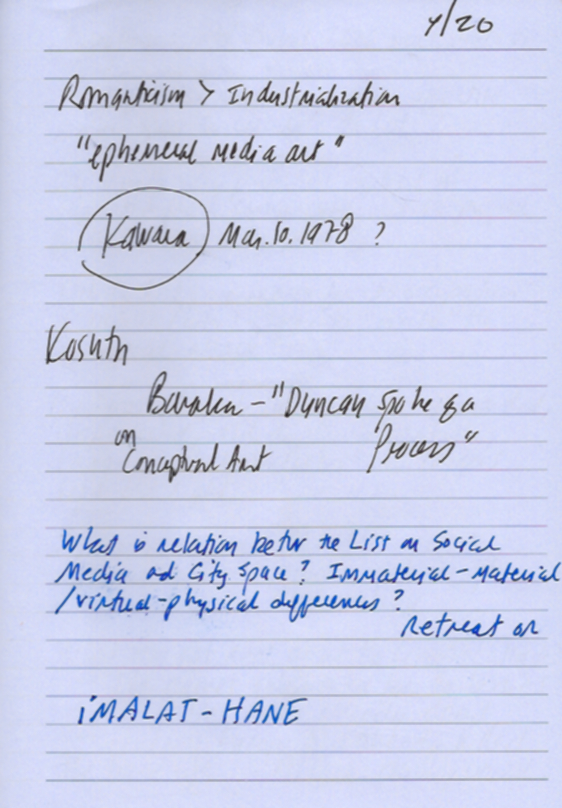
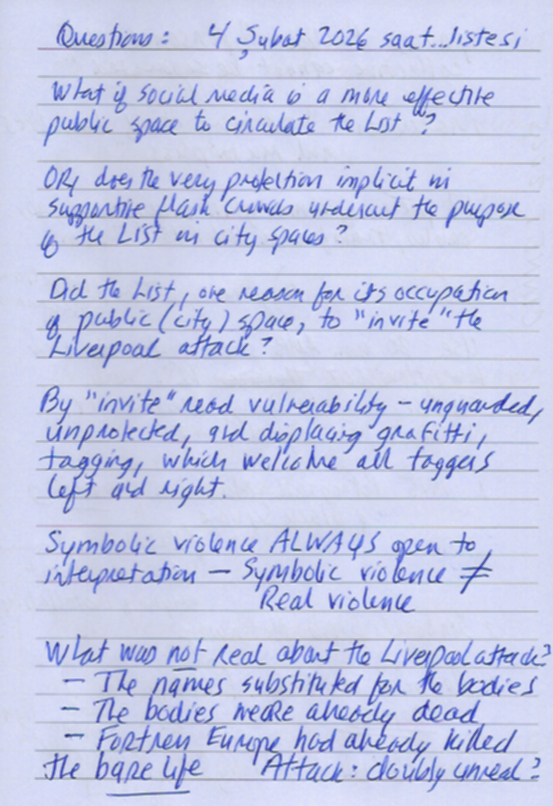

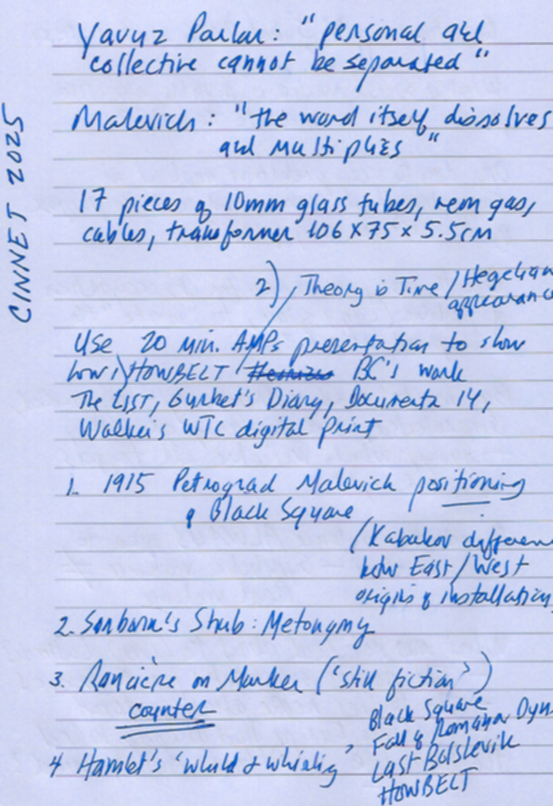
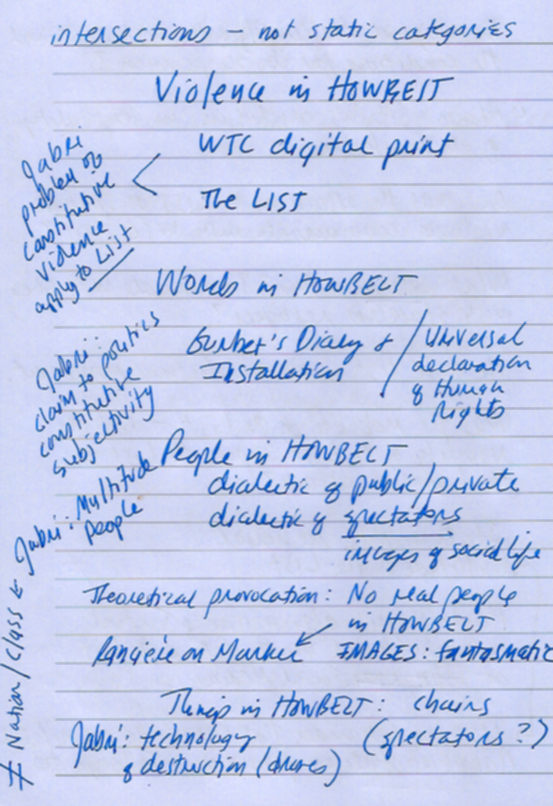
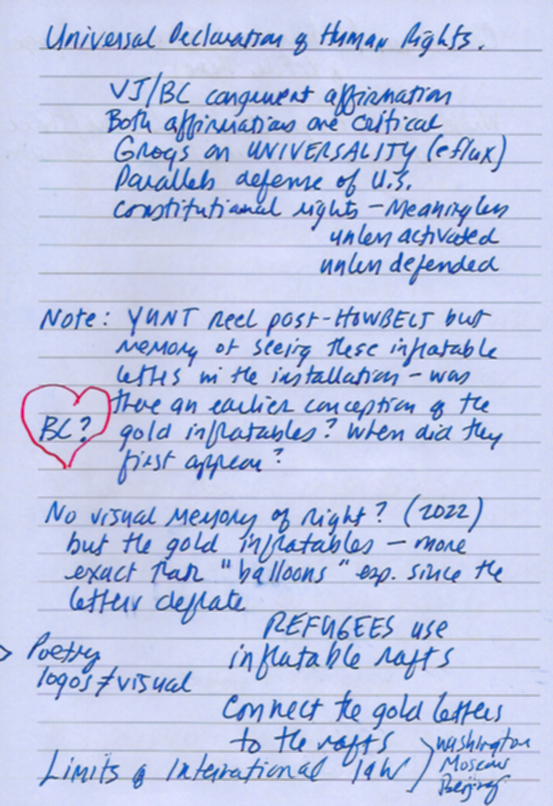
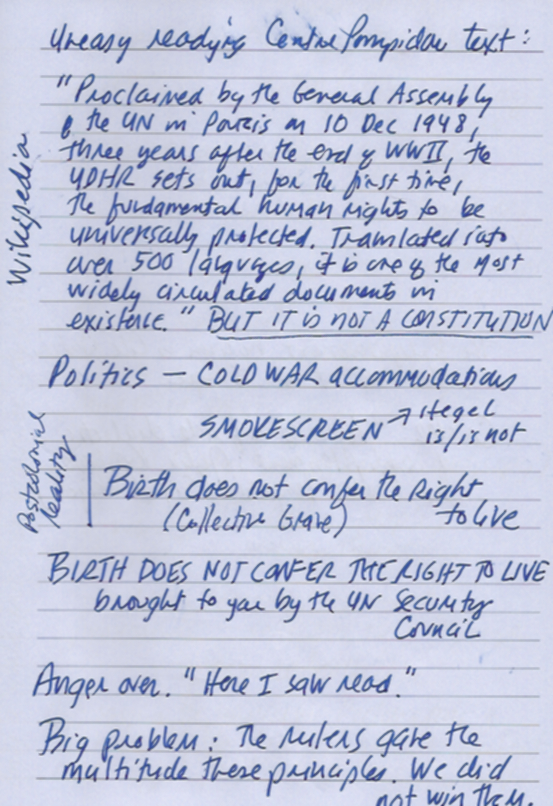
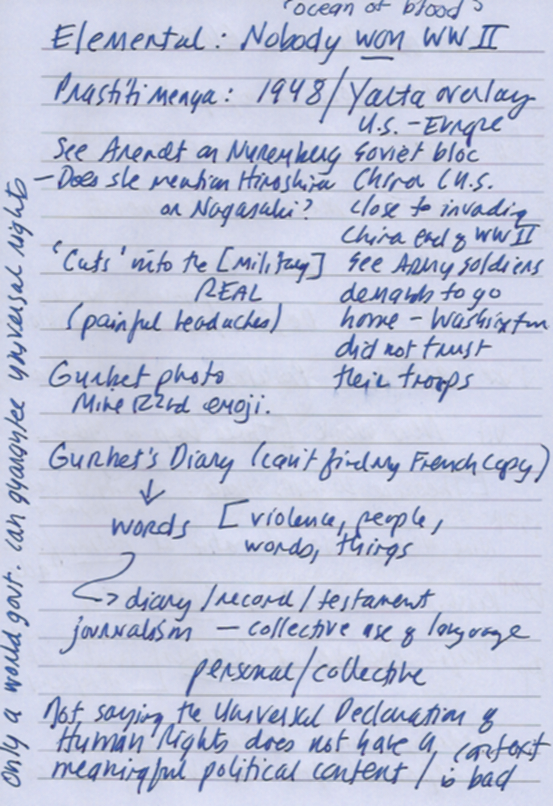

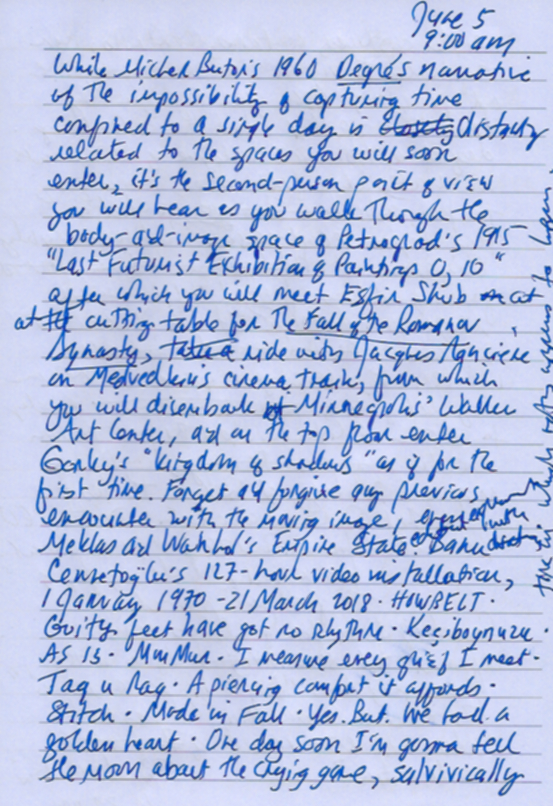
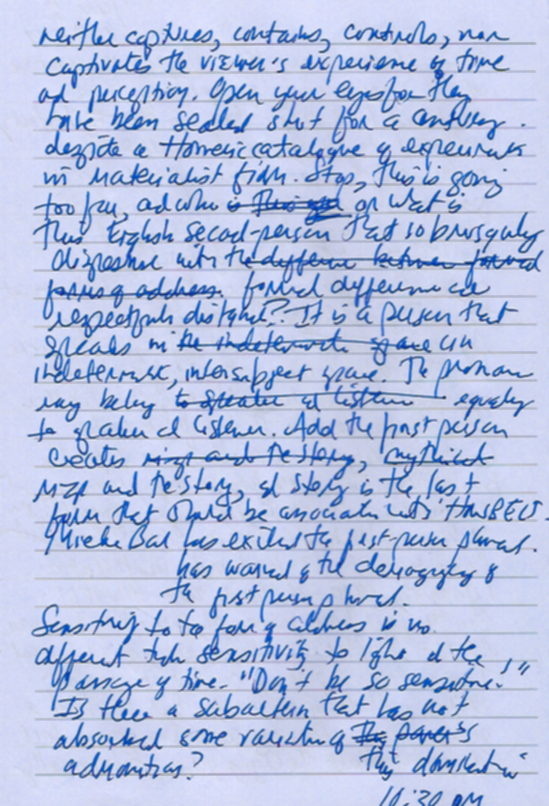
While the impossibility of a narrator capturing time confined to a single day in Michel Butor’s 1960 Degrés is remotely related to the spaces you’re about to enter, it’s Butor’s experiment with second-person point of view that will guide you to an exhibition space in 1915 Petrograd, after which you will meet Esfir’ Shub at the cutting table for The Fall of the Romanov Dynasty, then ride with Rancière on Medvedkin’s cinema train until changing stations at the Walker Art Center in Minneapolis, entering on the top floor Gorky’s “kingdom of shadows” as if for the first time. Forego any previous encounter with the moving image, even Meklas and Warhol’s 1964 Empire. Banu Cennetoğlu’s 127-hour video installation, 1 January 1970 – 21 March 2018 . HOWBEIT . Guilty feet have got no rhythm . Keçiboynuzu . AS IS . MurMur . I measure every grief I meet . Taq u Raq . A piercing comfort it affords . Stitch . Made in Fall . Yes. But. We had a golden heart. One day soon I’m gonna tell the moon about the crying game (HOWBEIT), salvivically refuses to capture, contain, control, or captivate viewers’ experience of time, sound, and sight. Open your eyes, for they have been sealed shut for a century despite a Homeric catalog of experiments in materialist film.
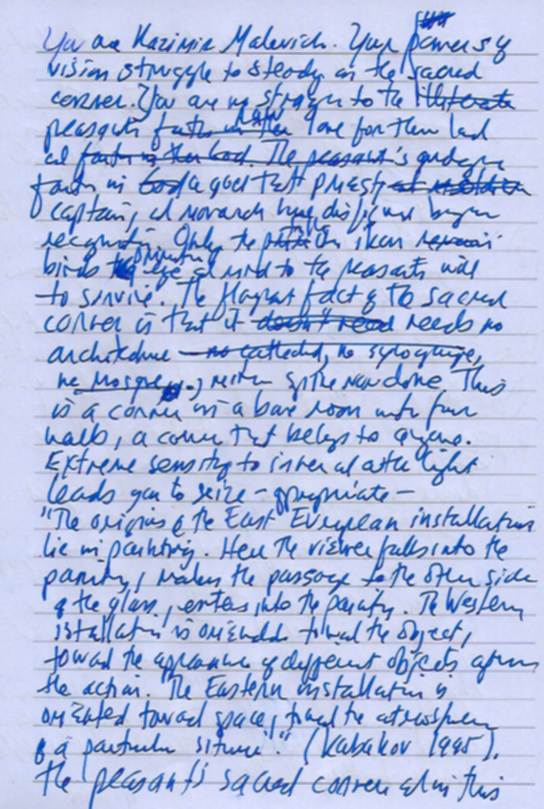
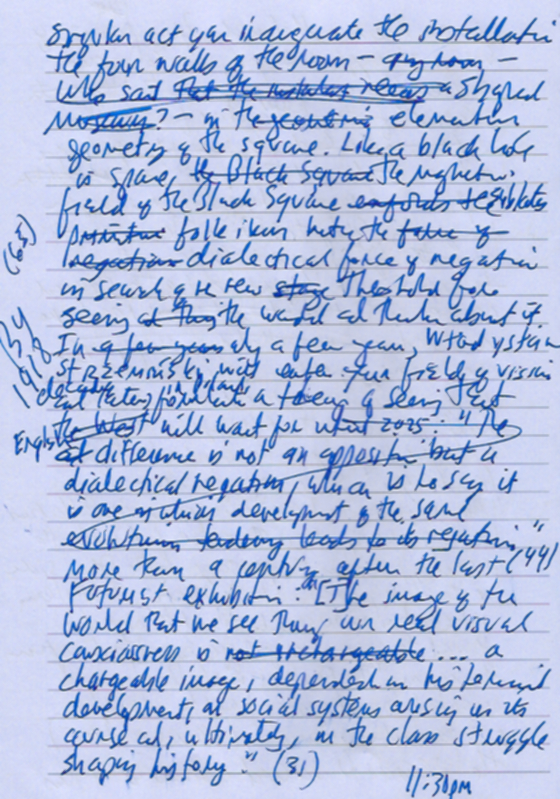
You come from the countryside, and your name is Kazimierz Malewicz or Kazymyr Malevych. The West will sand your name smooth to Malevich. Unlike the fields and open sky, the borders separating Poland, Ukraine, and Russia are unstable. In Petrograd, on the threshold of the space where you will position your Black Square, your power of vision struggles to rest on the sacred corner. You are no stranger to the peasant’s love for the land or faith in a god that priest, cossack, and czar have disfigured beyond recognition. Only the roughly-wrought ikon binds the weathered eye and mind of the peasant to the will to survive. The flagrant fact of the sacred corner is that it needs neither spire nor dome, only a space where two walls meet in a bare room to form a corner that belongs to everyone. Extreme sensitivity to outer and inner light leads you to seize—appropriate—the peasant’s sacred corner, and you inaugurate the installation’s body-and-image space, the four walls of the room mirrored by the geometry of your Black Square.
“The origins of East European installation lie in painting. Here the viewer falls into the painting, makes the passage to the other side of the glass, enters into the painting. The Western installation is oriented toward the object, toward the appearance of different objects after the action. The Eastern installation is oriented toward space, toward the atmosphere of a particular situation.” (Kabakov 1995).
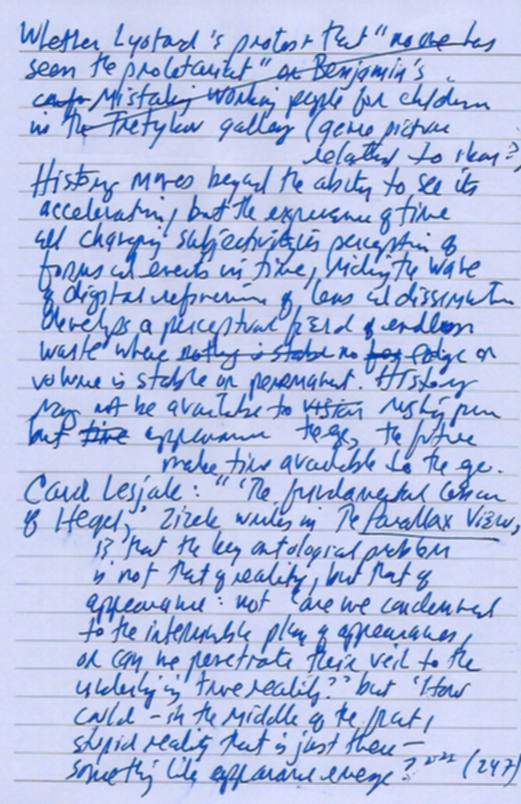
Three years from now, in 1918, Wladyslaw Strzeminsky will enter your field of vision and influence, elaborating decades later a theory of seeing that will wait for more than a century after the last Futurist exhibition for its English version: “[T]he image of the world that we see through our real visual consciousness is . . . a changeable image, dependent on historical development, on social systems arising in its course and, ultimately, on the class struggle shaping history” (2025, p. 31). If, as Lyotard once protested, “no one has seen the proletariat,” then it follows that no one can see history. But the experience of time and changing subjectivities’ perception of forms, emerging from refinements of lenses, digitalized images, and immediate dissemination and circulation, develops an audio-visual field of endless waste and repetition where no edge or plane is stable or permanent and where objects dissolve rather than materialize.
History may be rushing from the future, but only time is available to the eye’s craving for appearance. Carol Lesjak: “’The fundamental lesson of Hegel,’ Zizek writes in The Parallax View, is that the key ontological problem is not that of reality, but that of appearance: not ‘are we condemned to the interminable play of appearances,’ but ‘How could—in the middle of flat, stupid reality that is just there—something like appearance emerge?’” (247). The sudden, unexpected manifestation of appearance in fleeting, mutating forms is the discovery of Cennetoğlu’s HOWBEIT. The photographer’s discovery is the determination to document the vast expanse of “flat, stupid reality that is just there.” Appearance abrupts into view only if the eye drifts, floats, and flounders among attenuations of mundane, routine detail that aspire to deplete attention.
Question: Why do you speak from the second-person point of view?
Answer: Shorn by the single-form pronoun of formal difference and respectful distance, the English is spoken by a person seeking an indeterminate, intersubjective space suspending markers of nation or gender. You may belong equally to speaker or listener. Add the first person creates rings around the story, and story is the last form that should be invoked for HOWBEIT. Mieke Bal has warned of the demagogic danger of the first-person plural. Sensitivity to form of address is no different than sensitivity to light and passage of time. “Don’t be so sensitive!” Is there a subaltern that has not absorbed, against their will, some variation of domination’s right to speak and surveille?
Question: What claim do you have for appropriating the subjectivities of historical figures like Kazimir Malevich or Esther Shub?
Answer: Alonzo and Bitrán call this process “internalization” in their recent study of Malevich’s arkhitektons. Kantian intuition may also apply. Internalization derives from two texts, Homage to Ruth Berlau and Within Range of Authoritative Community, which both make extensive use of Malevich’s theoretical writings. Appropriation of rural subjectivity, whether pre-revolutionary Russia or America, expressed as love of God and of the Land (not Nation), is equally, globally,archaism and universalism, evidence for which may be instanced a song by Jason Molina (1973-2013), in whose voice an echo of the countryside of Kazimierz Malewicz/Kazymyr Malevych is singing. Listen in the rhyme of lamb for the shadow of the land, for the land is the lamb.

