ES: “without material of our days, the future will not be able to understand our present” (7).
KM: “I imagine a world of inexhaustible, unseen forms” (“The Artist,” 9).
ES: “The road ahead for me and my work is to present a film of authentic material of today with the real activities of people” (267).
Esfir’ (“Edi”) Shub, p. 102, My Life Is the Cinema, translated and edited by Keith Sanborn. Sticking Place Books, 2025. (Image for workspace purposes only).
Sergei Yutkevich writes about meeting you in Summer, 1927, in an editing room, 1st Goskino Factory, Zhitnaya ulitsa. It’s late at night, and he doesn’t know what to do with the strips of film he’s been given to edit. He finds you in the next room, working late. “She’s friendly, sociable. She’s always ready to help” (1). Everyone calls you Edi. But Yutkevich writes that you did not fully appreciate the importance of your “breakthrough” for the future of cinema by making the first full-length film composed entirely from archived images (6). Keith Sanborn calls you “one of the founders of the genre of films made from other films” (xi) Yutkovich titled his memoir: “Sorceress of the Editing Table,” and Alla Gadassik calls her essay: “A Skillful Isis: Esfir Shub and the Documentarian as Caretaker” (A Companion to Documentary Film History, Wiley & Sons, 2021). Jay Leyda’s term for your work is “compilation film.”
If Ruth Berlau photographed theater, you make film from reels of footage and photographs. “During these two months, I watched sixty thousand meters of film. For the film I selected five thousand two hundred meters. Fifteen hundred meters went into the film . . . The film (Fall of the Romanov Dynasty) consists of seven reels and with intertitles is one thousand seven hundred meters long” (110-111). Sanborn uses the difference between metaphor and metonymy to distinguish your work from Vertov’s, yet he uses metaphor to figure your difference: “she uses a slow burn, which ignites only after a long period of kindling, not an immediate conflagration, born of quick sparks” (496). He also writes that your films give “extraordinary attention to detail” and that your “sense of montage is subversive in its indirect quality” (497). Vertov’s cuts, for Sanborn, want to be absorbed by the viewer’s consciousness without the viewer’s active participation in processing them. He cites your criticism of Vertov: “this kind of montage helps the conception of the scene very little and leads the spectator to fall in love with the device itself” (501). Much of Barrett Watten’s The Constructivist Moment (2003) is premised on this formalistic innovation, the so-called ‘baring of the device.’ Against Vertov’s “utopian drive towards simultaneity, the eternal present of metaphor, the instantaneity of the single frame,” Sanborn affirms your “repeated insistence on a first name, a last name, and the date of a shot,” whose “catalogic impulses are indexical of a worldview driven by the pole of metonymy, of linearity, of historicity” (501).
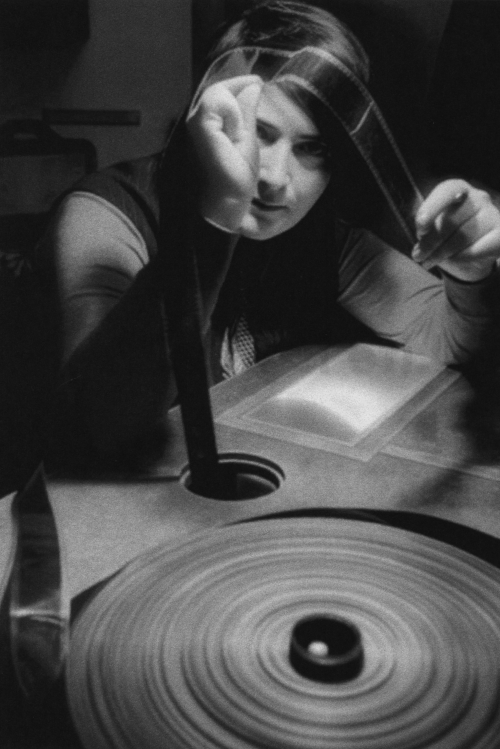
Esfir’ (“Edi”) Shub, flyleaf: My Life Is the Cinema, translated and edited by Keith Sanborn. Sticking Place Books, 2025. (Image for workspace purposes only).
“I learned how to properly assess the construction and composition of a shot. I cultivated a memory for shots, for the content and motion within the frame, for the rhythm of pacing of things as a whole. I interiorized when it was necessary and appropriate to change from a wide shot to a medium shot, from a medium shot to a close up and back again” (Shub 498).
But Sanborn also writes that you are “remembered in Russia by film historians of considerable standing only as one of Eisenstein’s lovers, or someone who used too much text” (504). Eisenstein’s April 14, 1932 drawing of you on p. 505 separates head and torso from your lower body by stretching an arch of flesh from the middle of which a lightbulb distends. The lightbulb’s significance should be seen in the light of Lenin’s 1921 calculation: “Communism= Soviet power + electrification.” (Notes on Electrification). The twenty of so marks for the rays of light emitted by the lightbulb are repeated in what looks like ten marks in an arc around your sex. Your collaborator and lover wrote on the drawing: “Esfir’ Shub having stepped on the throat of her own song.” (Your feet are on your neck). The text signals caricature rather than homage, although Bergan’s biography notes that it was at your “cutting table that the mysteries of montage were revealed to Eisenstein” (89).Still, the marks for the rays of light repeated around what looks like a cursive W to draw the center of your being engender a theory of the labial eye. Alonzo and Bitrán associate an “erotic impulse” with Zaha Hadid’s interiorities in her version of one of Malevich’s arkhitektons compared to the “pure exteriority” of the original. If a theory of the labial eye can be proposed, it will likely need Fanny Söderbäck’s 2021 Revolutionary Time: On Time and Difference in Kristeva and Irigaray.